|
|
(You will see a variation of the word "Extermination" used several
times in the documents presented below, as in the July 1877 British telegram,
"No. 90": "The Russians encourage the Bulgarians to
exterminate the Turks.")
It would be a
needless and painful task to collect, from the different reports that
have been addressed to this Embassy, the numberless cases of outrages,
cruelty, rape and massacre committed during the last few months by the
Russians and Bulgarians upon the Mussulmans of Roumelia. It would be
scarcely too much to affirm that they exceed in horror and amount the
accumulated misdeeds of four centuries of Turkish misrule. Never have the Turks, even in the worst days of their
history, been guilty of such indiscriminate slaughter, such shocking
outrages on women and female childeren, such universal destruction of
property, and such general religious persecution. The deeds of
the Bashi-Bozuks at Batak and in other Bulgarian villages, immensly
exaggrated by thoughtless, designing or unscrupulous men, and the
consequence of a panic which subsequent events have shown to have been
justified, were sufficient to arouse public opinion in England to such
an extent against Turkey, that a war unparalleled for its horrors, and,
perhaps for its consequences, has been the result. Yet the “atrocities” committed by the Russians and
Bulgarians, without cause or reason, upon an inofffensive and
defenceless population, upon old men, women and childeren, have passed
almost unnoticed, have excited but public little sympahty for the
victims, and have not affected the character for religion and humanity
of the nation that has been the cause of them. It can scarcely be
believed that this indifference should have arisen from the fact that
the victims are Mussulmans. Yet when the whole of
the European press unites in an outcry against the Turkish Government,
and demands justice and vengeance, because houses in a Greek village in
insurrection are injured, its church plate stolen, or some of its
inhabittants killed, and almost passes over in
silence the shocking cruelties, perpetrated upon the Mahommedans of
Turkey, it would seem that public opinion is not altogether
uninfluenced by this consideration.
British Ambassador Henry Layard, sourced in an article
written by Kemal Karpat, from the 1970s-80s; thanks to Erman. Has much
changed since?
|
The Russians set the blueprint for Muslim "Death
and Exile," with their criminal campaigns throughout the 18th and 19th
centuries typified by, for example, General Yermelov in 1818, versus the Chechens. The Russian
strategy was to massacre Muslims, frightening the rest away, in order to claim
the Muslims' centuries-old-homelands. Because Muslims were a dirty word in the
hypocritical West, the Russians had carte blanche to get away with their evil
work. Whole people were decimated and booted out, as for example, with the
Circassians. (And the Laz. And the Abhazians. So many more... their last stop
being the Ottoman Empire. Naturally, with hundreds of thousands of refugees to
deal with, the Sick Man kept getting sicker; but that was part of Russia's
wicked plans as well.)
Meanwhile, the dishonest and hypocritical genocide industry does not give a
roach dropping for the catastrophic miseries the Muslims suffered. Among them
were principally Turks. That would go against the genocide industry's racist
game plan, to actually give victim status to one of their most profitable
villains. (Not that the Turks are looking for victim status; they are not that
sort of people.)
An interesting phenomenon is that the sick Russian way of operating caught on
big time with their Orthodox cousins. We got a taste of this in recent memory,
with the abominable behavior of the Serbs and the Bosnian Serbs, during the
break-up of Yugoslavia. But merciless treatment by the Serbs enjoys a rich
history. The same with the Greeks, the Bulgarians, the Montenegrins, and, of
course, the Armenians. (Who similarly gave us a recent taste of the preferred
old massacring ways in
their conquest of Karabakh, in 1992. The biased West turned a blind eye.)
The weird thing is, whenever these Orthodox peoples got into a situation to
exhibit their bloodlust, they sometimes went about their ethnic cleansing work
in the most devilish of ways. Truly, it defies human comprehension, the way in
which they misbehaved. (As only one example, from the many horrendous ones
you'll be reading: they would amputate a woman's arms, simply for sport! In
another example, all of the fingers of a woman would be cut off. The maniacs
involved seemed to be targeting women and children on purpose.)
The war was not only a calamity for the Ottomans in the Balkans, but in
Eastern Anatolia as well. When the Russians invaded the east in 1878, it
served as one of the many times the Armenians traitorously lent a hand. At
this stage, the Armenians did not behave as systematically as the Bulgarians
(the Armenians got their chance to outdo the Bulgarians, at least in numerical
terms of greater victims, and at least a similarly sadistic "creative
joy" of killing, come WWI), but they mistreated and massacred Muslims and
others, as well; particularly with the conquest of Erzurum.
Usually, such brutal behavior is expected of the Turks. Yet this was part of
the Orthodox M.O.; not that the Turks were always innocent, but we can see
with one of the British documents below that the Orthodox would do the crime,
and then blame the same crime on the Turks... in full knowledge that a ready
and sympathetic ear would be waiting on the prejudiced Western end. Turkish
crimes to this degree were usually obtained through hearsay; the word of
missionaries and Armenians, for example, that usually found the ears of the
sympathetic consuls. The Orthodox crimes, on the other hand, usually had
"back-up" from Westerners. So we could count on their accuracy.
(The documents below will also feature internal Ottoman ones. Those among you
who can't get over your anti-Turkish fetish, remember: these reports cannot by
construed as propaganda, as they were never meant to be publicized.)
|
|
|
| Historical
Backdrop on the Documents Below |
The Bulgarians of the Ottoman Empire got bolder as the Ottoman Empire declined,
particularly with the the help of the missionaries. (An Armenian had written to the Boston
Herald, regarding the founder of Robert College, Cyrus Hamlin: 'I heard him lecture at Amherst, Mass. How proud he
was to tell his audience the important part taken by the Bulgarian graduates of Robert
College in securing the freedom and independence of their country.') The Bulgarians
had already sided with the Russians, when the latter had invaded the Balkans, in 1806,
1811, and 1829. (No differently than the Armenians, beginning in the same time frame.)
On May 2, 1876, Bulgarians revolted, slaughtering Muslims, eventually killing an estimated
1,000 and destroying 3,000 Muslim houses. Few troops were available to quell this
rebellion, so the Ottomans armed the Circassians. Bad idea; they could not be controlled,
and they likely harbored a distrust of Christians (and a hatred of Russians, with whom
they probably compared the Bulgarians), after the inhuman way in which they had been
exiled from their homeland.
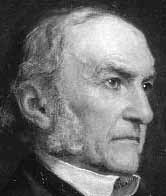 |
|
William
Gladstone |
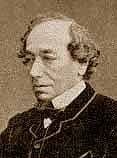 |
|
Benjamin
Disraeli |
The Bulgarians soon learned that it did not take much to incite the
Circassians. "The insurgents committed acts of violence, particularly against Muslim
women, with the obvious intent of sparking a retaliation," wrote one British consul (F.O.
195-1077, 27 May 1876). (This was, of course, the same tactic the Armenians would adopt in
later years.) The resulting "Bulgarian Horrors" were a reaction to murder of
Muslims, naturally sensationalized, as with tales of Christian girls sold into slavery
(sound familiar?); "Whipped up by religious sympathy and prejudice and the political
opportunism of Gladstone and the Liberal press, public opinion in England made it
impossible for Disraeli to come to the aid of the Turks, despite his own wish to do so.
The final result was a massacre of Muslims in 1877-79, much greater than any massacre of
Bulgarians in 1876. (Justin McCarthy, Death and Exile, 1995, p. 64. Please
consult this excellent book, for an overall view. The objective sources for the above
claims have all been provided.)
Tally for the latter: 3,000 to 12,000 * dead Bulgarians, vs. 1,000 Muslims.
Tally for the Muslims, 1877-79: 261,937, a loss of 17%.
Isn't that incredible?
Today, all we still keep hearing about is how the Turks massacred Bulgarians...130
years later! This is the power of prejudice.
An eye-opening communication by a British consul featured in the relevant chapter of
McCarthy's book has already been reproduced
in TAT; Edmund Calvert compared the evils by and against Turks. The Turks come out well
ahead. ("...By universal consent, Turkish venality and corruption at its worst is
purity itself compared to its local Russian counterpart," is how Calvert put it.)
As you will see in the documents below, when the Ottoman Muslims had the upper hand, they
usually did not touch the women and children; and their massacring methods may have gotten
the job done, but did not appear to have the sadistic "creative joy," as in the
case of the Russians (usually Cossacks) and the Bulgarians.
Another point to bear in mind was the intensity with which Jews were targeted. There were
more Jews in this area of the Balkans, meaning more Jewish victims... but the targeting of
Jews was followed faithfully by Armenians as well, when the Armenians had their turn for
systematic extermination in Eastern Anatolia and Cilicia, during and after World War I. In
addition, we all know how Armenian propaganda loves to solicit pity by reminding us that
Armenians were resettled into the "desert," when in fact the Armenians were
transported to the region historically known as "The Fertile Crescent," a
generally forgiving environment.
Meanwhile, when the Russians forced populations to move (rarely with the provision that
the move was meant to be temporary, as was the case with the Armenians), their
unfortunate victims would often find themselves in Siberia. (A document below will
point to the unwanted being destined to this horrible destination.)
One more point of interest: this was the war — disastrous for the Ottomans — where the
battle of Plevna was fought. The heroism
displayed turned some European public opinion around, in favor of the Turks.
Here we go:
* The higher figure of 12,000 Bulgarian dead was an estimate of an American
consular official (Schuyler), working with a reporter from the anti-Turkish Daily News
and a Bulgarian interpreter. Here's what C. F. Dixon-Johnson wrote in a letter to The
New Age (Dec. 16, 1915, Vol. XVIII. No. 7): "The need for this would be clear
when we remember that the original figure of 60,000 which was given as the number of
Bulgarian Christians slaughtered in 1876 was proved on the authority of Sir Henry Layard,
the British Ambassador in Constantinople, to have been ‘about 3,500 souls,
including the Turks, who were, in the first instance, slain by the Christians.’"
|
|
RUSSIAN ATROCITIES
IN
ASIA AND EUROPE
DURING
THE MONTHS OF JUNE, JULY, AND AUGUST 1877.
CONSTANTINOPLE
PRINTED BY A. H. BOYAJIAN
1877.
A collection of various official and private telegrams respecting the atrocities
committed by the Russians in Asia and Europe during the months of June, July, and
August 1877.
Series Editor’s Notes
Russian Atrocities in Asia and Europe is an unsophisticated work. In the book the
Ottoman Government simply printed reports from officials and individual Muslims who
had suffered in the 1877-78 Russo-Turkish War, with little editorial comment. It is
thus a valuable historical document, although it cannot have been
of much use as propaganda.
The book contains numerous misspellings and grammatical infelicities. Only the most
obvious misspellings of ordinary words have been corrected. Names and descriptions
often appear in the text in more than one form. For example, the Turkish form of the
name Muhammad, Mehmet, appears as Mehemmed, Mehemed, Mehemet, and Mehmed. The
meanings of these are obvious and have been left unchanged. Spellings and
definitions that are not obvious are listed below.
Abaxes (Abhaz) natives of the Eastern Black Sea region forced from their lands by
the Russians and settled in the Ottoman Empire
araba wagon, drawn by horse, donkey, or water buffalo
Arnautlu Albanian
bashi bozouk irregular soldier, drawn from the populace in time of war.
caïmakam (kaymakam) head official of a district (division of a sancak)
Circassians natives of the Eastern Black Sea region forced from their lands by the
Russians and settled in the Ottoman Empire
muderris (müderris) head teacher in a Muslim religious school
mudir (müdür) official in charge of a sub-district, mayor
mutessarif (mutassarıf) official in charge of a sancak (division of a province)
seraskier (serasker) commander-in-chief of the army
Tatars natives of the Crimea, forced from their lands by the
Russians and settled in the Ottoman Empire
zaptieh (zaptiye) gendarme
zeïbek (zeybek) infantryman
PREFACE.
The letters and dispatches, official and private, which are published herewith cover
a large area of territory, and come from many different personages. They refer to
incidents which have happened during the last few months in various parts of the
Empire, and they combine to strengthen each other’s testimony.
From the statements they contain, it will be seen that the Russians invading Turkey
in the name of religion have had for their object the extermination of the Turkish
race; that they have hesitated at no cruelty or excess however terrible to
accomplish this work, and that they have actually succeeded in depopulating and
desolating vast, populous, and thriving districts.
It will also be noted that this terrible example has been followed not only by the
semi-savage Cossacks who have accompanied the Russian forces but also by the
ignorant and excitable Bulgarian peasantry, with a result so deplorable that history
produces no parallel.
In offering this concurrent testimony of many witnesses to the English public the
Ottoman Government desires to rouse no revengeful feelings, but rather to show that
Russia has no right to claim the mission of “Humanity’s Champion” and that in
invading Turkey she is prompted by no other sentiments than those of greed, ambition
and hate.
Upon the misery which this cruel and unjustifiable war has caused it is needless
here to dwell. A perusal of the following pages will bring its own conviction to
mind of any impartial and reasonable person. Unhappily the mute protest of a myriad
victims reaches the ear of Europe too late for succour; and even the conviction of
Russia as the cause of their sufferings will not avail to restore to them either
their homes, their honour or their lives. Yet should the
story of their grief be impartially told; and it is to this task that the Ottoman
Government has now addressed itself.
Holdwater: Too bad the author did not identify himself.
At any rate, let's get to the nitty-gritty...
|
| |
No. 1
(Extract from divers telegram addressed to Sublime Porte.)
The Russians commit the most unheard of outrages on the Mussulman population of the
Caucasus. They burn and pillage the Mussulman villages; oblige the inhabitants to become
Orthodox Christians under the pain of being immediately put to death, and profane the
mosques and schools. The women and girls are massacred after having suffered the most
shameful outrages, and the male part of the inhabitants who have been spared are sent to
Siberia.
All these horrors are perpetrated by the orders, and under the eyes of the chiefs of the
Russian army in compliance with a pitiless order which has for its object the systematic
and premeditated annihilation of all the Mussulman population.
Ardahan has been equally the scene of revolting atrocities. In occupying this town the
Russians gave themselves up to the most horrible acts, proceeding by violence, massacre
and pillage.
No. 2
(Extract of telegram addressed to Imperial palace by Governor of Erzeroum.)
The same day of their entrance into Ardahan, the enemy fired on the hospital without
regard to the flag which was flying on the top and killed several sick and all the warders
of the hospital. To avenge themselves on the inhabitants of Avilar who served in the
Imperial army, the Russians shamefully maltreated their parents and dishonoured their
women and their daughters. Among others, the family of the Vice-Governor of Zarenhad who
was then in service at Kars, has been interned in Russia after having suffered an ignoble
treatment.
Besides the Russians have sacked the villages of Djevra and Hadji Tchiflik under the
pretext that several inhabitants give themselves up to espionage. The population despoiled
of everything even to the last stitch on their back have been sent to Kars in a state of
complete nakedness.
No. 3
(Telegram from his Excellency Mehemmed Ali Pacha to Ministry of War, dated June 12/24,
1877)
On the 31 st of May last the Montenegrins in invading the village of Schtouze, on the
banks of the river Jara, a dependence of Vranieh (Akova) cut off the nose, lips and arms,
of three soldiers of the battalion of reserves of Salonica, massacred a boy of 11 years,
and also cut off the nose, right cheek, the lips, and mustaches of a soldier named
Mehemmed Bin Hassan, belonging to the 4 th file of the 8 th company of the battalions of
reserves of Gamuldjéné. This unfortunate man twelve days ago finished by falling into
the hands of the Montenegrins.
No. 4
(Extract.)
On Wednesday, 20th June, about eleven in the morning a Russian boat came and boarded an
Ottoman merchant vessel anchored at Aïdos, and placed inflammable matter on it, which it
was not long in exploding.
The same day, some torpedo-launches were directed on three Ottoman merchant vessels,
respectively commanded by Captains Hadji Hassan, Hadji Feïzi and Serda, anchored before
Couri-Chilé, 15 miles distant East of Amasra. The launches caused the three vessels to
capsize and a great part of the equipage was lost.
No. 5
(Telegram from Commandant of Van and Bayazid to Minister of Interior, dated June
19/July 1 1877.)
I have already had the honour of writing you that the Russian division operating on the
Alashguerd side, finding at length that it could not make head against the attacks of the
Imperial troops had commenced to withdraw.
The commander of this division has taken the part of pillaging everything on his passage.
He burns all the Christian and Mussulman villages, takes and lifts the goods of their
inhabitants. Independently of these revolting outrages committed, he has killed three
women.
The Powers can in reading the publications of foreign correspondents, convince themselves
of the exactitude of these reports.
No. 6
(Telegram from his Excellency Moukhtar Pasha to Ministry of War, dated June 23, [July
5] 1877.)
The Russian detachment of Ardahan composed of three battalions of infantry and 500
cavalry, has invaded the route of Ardanaich and attacked the auxiliary troops who were on
the point of concentrating.
The latter withdrew but as a portion of the inhabitants of the villages of Khalt de Doba,
of Rchidil, of Oreniskhew, of Missitch, of Penek, of Meria, of Senatus and of Pouskhew had
taken recourse to arms, the enemy did not spare a single person who fell into their hands;
massacred about fifty persons without distinction of age or sex and pillaged and burned
several buildings. In short, they committed every act condemned by the rights of men.
No. 7
(Telegram from Ismail Pasha, Governor-General of Erzeroum to Ministry of Interior dated
July 5, 1877)
I learn at this moment that the Russians have taken with them by force by the Armenian
bishop of Utch-kilissa, after having wounded and garroted him.
This prelate was devoted to the interests of the State.
No. 8
(Telegram from Saïd Pasha, Governor of Tirnovo, to His Highness the Grand Vizier,
dated July 5, 1877).
Yesterday the enemy’s cavalry having surrounded the Mussulman village of Batah, situated
7 hours from Tirnovo, in the district of Sistow, took all their cattle and then captured
by force from their inhabitants the arms, and money, in short everything they had. They
then set fire to their habitations, and massacred a great number of the villagers.
No. 9
(Telegram from Seraskier and Namyk Pasha to the Grand Vizier, dated July 6, 1877.)
The Governor of Tirnovo furnishes us with the following:
“On Wednesday last, some Russian cavalry having surrounded the Mussulman village of
Batah, in the caza of Sistow, lifted all the cattle and took by force from the inhabitants
their arms, their money and all their possessions. They then set fire to the dwellings and
massacred a great number of villagers. “Besides this, six Mussulman individuals of the
same caza, set out for the village of Yazidji to search for their cattle. Having been met
on their return by the enemy one of them was killed and the five others were taken
prisoners.
“Seven others Mussulmans returning from Roustchouk to Plevna, their native place, were
assailed by the enemy’s horsemen, who killed six of them; the other managed to escape.
The Russians torture the bodies of their victims, pulling out their eyes from their
sockets and replacing them by small pieces of bread. The same cruel acts are witnessed
wherever the Russians enter. We deem it our duty to inform your Highness in order that the
Government may act as it thinks necessary.”
No. 10
(Telegram from Governor of Tirnovo to Grand Vizier, dated July 7, 1877.)
Travelers from Berkoftcha report that a column of the enemy debouching from the high road
of Servi have this night burned a Mussulman village and two villages of mixed population
situated some hours distance from Tirnovo.
|
|
No. 11
(Telegram from Commander of Batoum to 1 st Secretary of Palace, dated July 8,
1877.)
In the battle of Tchamtchira of which I have already furnished you with a report,
the Russians directed their fire on the spot which we had converted into an hospital
though it was surmounted by the Red-Cross. Some of the wounded whom it contained
have been killed being unable through their wounds to save themselves.
In reporting to you this fact I cannot but stigmatise and denounce the savage acts
committed by the enemy who tread under their feet a symbol adopted and respected by
all civilised people.
No. 12
(Extract.)
A Russian division arrived on the 7 th July at the villages of Kestan and Belovan,
disarmed the Mussulman inhabitants and distributed their arms to the Bulgarians.
They then proceeded against the Mussulman population, massacring the men, women and
children, and burning their dwellings.
No. 13
(Telegram from Governor-General of Danube to Sublime Porte, dated July 11, 1877.)
Private dispatches confirmed by our own reports, show that amongst the others the
Russians advancing from Toultcha side, massacre without pity all the Circassians
that they meet.
No. 14
(Extract of divers telegrams from the vilayet of Danube.)
Two villages, Oustroudja and Kadisla, situated five hours distance from Roustchouk,
have been sacked by the Cossacks who have massacred about thirty Mussulman
inhabitants without distinction of age or sex.
At the village of Bin-Bounar, they cut off the dresses of the women and girls as far
as the waist, and then violated them in the presence of their parents. All the male
portion of the inhabitants have been taken prisoners, and a woman has had her arms
amputated. The Cossacks having encountered at seven hours distance from Roustchouk
some Mussulmans who had abandoned their villages and were flying to the mountains,
massacred them without sparing even the women and children.
No. 15
(Telegram from Governor-General of Adrianople to His Highness Grand-Vizier, dated
July 12, 1877.)
I have the honor of transmitting the following telegram from the Vice-Governor of
Kezanlik, communicated by the Governor of Philippopoli.
The Mussulman inhabitants of Balova and of Roubetcha in the dependency of Tirnovo,
in seeking flight across Haïn Boghaz, were pillaged and massacred by the Christian
population of the Balkans.
This fact has been reported by a person who managed to escape the massacre and
regain the Mussulman villages situated below the Balkans.
No. 16
(Telegram from Mr. Jourdan to Mr. Gay, Hôtel d’Angleterre, Pera, dated July
1st 1877.)
On entering Tems, a village situated an hour’s distance from Tirnovo, the Russians
burned alive the Mussulmans who had taken refuge in the mosque.
No. 17
(Telegram from Mr. Jourdan to Mr. Gay, Hôtel d’Angleterre, Pera, dated July
1st 1877.)
The Russians give themselves up to the most unheard of outrages with regard to the
Mussulman population. They burn the Mussulman quarters, cities and villages which
they find on their passage.
Three hundred wagons loaded with Mussulman families flying in the direction of
Kadi-Keuy were attacked and destroyed by cannons. The enemy has achieved his work of
extermination in massacring all the men and women whom he met.
The outrages committed by the Bulgarians on the Mussulman population surpass a
thousand times those of the Muscovites. The Mahometans do not follow the less an
exemplary course.
No. 18
(Telegram from His Excellency Ahmed Moukhtar Pasha, to Ministry of Interior,
dated July 3rd , 1877.)
In an engagement fought about a month ago, between the Russian and some battalions
of infantry detached from Kars to make a reconnaissance of the positions occupied by
the enemy near Mount Simwas in the neighbourhood of Kars, our troops had some killed
and wounded whom they were not able to bring with them during their retreat.
The following day Hussein Hami Pasha, commander of Kars, sent his aide-de-camp,
Osman Effendi, accompanied by several men bearing a white flag to reclaim our dead
and wounded. But the Russians without any respect for the rights of men, fired on
our deputation who in vain made signs to them to cease. The enemy’s fire
continuing without the signals having been observed Osman received a wound on the
left arm which still confines him to the hospital.
No. 19
(Telegram from Governor-General of Adrianople to His Highness Grand-Vizier, dated
July 4, 1877.)
I have the honor of transmitting you herewith a telegram from the vice-governor of
Kezanlik communicated by the Governor of Philippopoli.
To-day, a detachment of a hundred and thirty of the enemy’s horsemen burned the
villages of Iflehanle, of Baighiuli, of Kozlidja and of Tchanaktchi, dependencies of
the district of Kezanlik.
This bad news has been given me by Suleyman Agha who just comes from those
localities.
No. 20
(Telegram from some notables of Philippopoli to His Highness the Grand Vizier,
dated July 5, 1877.)
The Russians have passed at Kezanlik, at three hours distance from Carlova. They
have carried away the Bulgarians; and have burned some villages and massacred their
inhabitants without sparing even the children at the breast.
Consternation is general. We must now have recourse to the protection of the
Imperial Government.
|
| |
No. 21
(Telegram from His Excellency Ahmed Moukhtar Pasha to Ministry of War, dated July 5
1877)
The enemy in withdrawing from Chourakul and Zarouchal. districts relating to Kars, cut
down the corn they found on their passage and have left nothing for the villages, having
taken everything into Russia. Besides this they have demolished all the dwellings, burned
much material and taken with them such as they could not burn.
The poor inhabitants are vividly impressed by these acts of barbarity; they find
themselves reduced to a state of misery truly pitiable.
The Russians have carried with them to Alexandropol as prisoners, the wife and children of
Youssouf Bey, Caïmakam of Chourakul, who has taken refuge at Erzeroum, his brother
Mehemmed Bey, and his children and the sisters of Hatoum Zadé Emin Bey, notable of
Chorakul; in short, all the women of the household of the Caïmakam of Karouchal, Youssouf
Bey who has taken refuge at Kars.
These prisoners who have been made to undergo all kinds of outrages are at present
forwarded to Tiflis.
A great number of Mussulmans have been subjected under some pretexts to the most horrible
treatment.
No. 22
(Extract of Telegram addressed by Caïmakam of Loftcha to His Highness the Grand
Vizier, dated July 6, 1877).
At the end of an engagement which took place yesterday, and in which our troops found
themselves obliged to retire, the Russians ruthlessly commenced to bombard the town which
cost the lives of several children. The Mussulman population took instant flight
barefooted.
No. 23
(Procès verbal prepared and signed at Choumla by the Correspondents of Foreign
newspapers, dated 8/20 July 1877)
The undersigned representatives of the foreign press, united at Shumla, think it a duty to
collectively resume and affix their signatures to the statements of facts that they have
separately addressed to their respective journals, respecting the acts of inhumanity
committed in Bulgaria against the inoffensive Mussulman population. They declare that they
have seen with their own eyes and interrogated at Rasgrad and at Shoumla, children, women
and old men wounded with thrusts of the lance and with sword cuts, without speaking of
wounds caused by fire arms which might be attributed to the chances of an equal contest.
These victims give a horrible description of the treatment which the Russian troops and
sometimes the Bulgarians inflict on the fugitive Mussulmans. According to their
declarations the Mussulman population of several villages has been entirely massacred
sometimes on the road, sometimes in the villages given up to pillage. The undersigned
state that the women and children are amongst the most numerous of the victims, and that
the wounds are made by the lance.
Here follow the signatures:
C. Fitzgerald,
Emerick Bulkovics,
J. W. Saterger,
August Jacquot,
Charles Winter,
Henry Dimone,
Harry Suter,
Nelton Prior,
Jules Zukab,
Wentworth Huyshe,
Senanian Camille,
Borthwick,
Barrère, Drummond,
Carl Mayers
No. 24
(Telegram from Governor-General of Danube to Grand Vizier, July 8, 1877.)
Sunday last, the Russians and Bulgarians attacked the village of Yenikeuy, situated 8
hours from Osmar Bazar, and massacred all the inhabitants with the exception of three
women and two men.
The day before yesterday the village of Kozli, nine hours distance from the same town, was
invaded by the enemy who put five persons to death after having taken all the cattle and
things they could lay hands on.
No. 25
(Telegram from Tewfik Bey to Ministry of Foreign Affairs. Shoumla July 9/21 1876.)
To-day Mr. Reade, British Consul at Roustchouk, and M. DeTorcy, French military attaché,
visited one and twenty wounded, viz., ten women and eleven children of whom two were still
at the breast and respectively aged 8 to 10 months.
No. 26
(Telegram addressed by Ahmed Fehim Pacha to Minister of Interior, 9 July 1877).
The present war, which Russia has undertaken against us is without precedent in the annals
of history, and does not resemble any of those international wars which have taken place
up to the present time, sanguinary and barbarous is the aggression.
The enemy seizes upon undefended villages and after having destroyed them by the fire of
canons, massacres the unarmed inhabitants. They take the women and outrage them when they
do not put them to death.
The news of these cruelties having reached the neighbouring villages, has forced the
Mussulmans to emigrate.
The Russians threaten the Christian villages with the same fate if the inhabitants do not
submit and enroll themselves, and the latter likewise have been obliged to leave their
hearths on the enemy’s approach and take refuge in the village of Orkhanié.
No. 27
(Telegram from Mutessarif of Tirnovo to the Grand Vizier, 9 July 1877).
The enemy having occupied Tirnovo continued his march forward, burning all the Mussulman
villages, and distributing arms to the Bulgarians which he took from the Mussulmans by
deceitful promises. They pillaged the goods of these unfortunates, destroyed their
dwellings, took the young Mussulman women and girls, and destroyed the rest. It is only a
few days since that the inhabitants of Chemsi-Keuy in the district of Tirnovo were burned
alive in a mosque where the enemy had enclosed them.
The policy of the Russians seems to be the total extermination of the Mussulman population
of the Balkans and they employ as tools, in the execution of this work, the Bulgarians,
with the object of preventing for ever the possibility of an understanding between the two
races.
For this purpose the enemy obliges the Mussulman prisoners, under penalty of death, to
fire on the Imperial troops who come to their succour.
No. 28
(Approximate estimate of the number of dwellings burnt and of Mussulmans massacred by
the Russians and Bulgarians since the occupation of Tirnovo by the enemy).
1. Batak, a village exclusively Mussulman (burnt) in the district of Sistow: 100 houses;
inhabitants, men 200, women 300. Persons reputed surviving 7.
2. Balovan, Mussulman village (burnt), district of Tirnovo: 250 houses; inhabitants, men
700, women 1,100, total 1800. One person only, we learn, succeeded in escaping.
3. Caya Bounar (burnt): houses 100; men 200, women 300, total 500. Two persons only
escaped death.
4. Kestambol: houses 250; men 300, women 600; total 900. Survivors 3.
5. Chemsi, mixed village: Mussulman houses 60; men 120, women 200, total 320 inhabitants.
One person only made good his escape. The Mussulmans were burnt alive in a mosque where
they had taken refuge.
6. Tundja, mixed village, 100 houses, men 250, women 400, total Mussulmans 650. Survivors
3.
The following is the list of the number of houses burnt in the villages which had been
deserted by their inhabitants, before the arrival of the enemy.
Tranich Homri, houses 40
Revan “ 130
Odalar “ 180
Armoudlouk “ 80
Bourouch “ 100
Kodjina “ 70
Okdjilar “ 200
___
Total number 820
There still exist forty or fifty mixed villages, counting each at least 100 houses. The
Mussulman inhabitants have submitted to the Russian yoke but we are ignorant of their
fate.
No. 29
(Telegram from His Excellency Suleyman Pacha to the Ministry of war, 10 July 1877).
The Governor of Philippopoli telegraphs me on the instant that, 12 unarmed Mussulmans of
the village of Sounkourlou, near Eski-Zaghra, having made their submission to the
Russians, 7 of them were killed by strokes of the hatchet by the Bulgarians and three
others by the Cossacks. Two only succeeded in saving themselves.
|
|
No. 30
(Telegram from the Governor General of Adrianople to the Grand Vizier, July 10,
1877.)
Yesterday evening twelve Mussulmans of Sounkourlou, a village burnt by the enemy,
were, after having delivered up their arms, attacked by the Cossacks, who put in an
appearance near this village to the number of about 30. Three of these unfortunate
villages were massacred by the Cossacks, and seven others were dispatched by strokes
of the hatchet by the Bulgarians of the neighbouring villages. As for the others,
they succeeded in making good their escape.
These facts are the contents of a telegram from the deputy Governor of Tchirpan,
communicated to the vilayet by the Governor of Philippopoli.
No. 31
(Telegram from His Excellency Ali Saib Pacha to His Highness the Grand Vizier,
July 10, 1877).
I have the honor of bringing to the knowledge of your Highness, the following facts
reported by the police:
“Seven children, boys and girls, of the village of Globofdja, district of
Podgoritza, having fallen into the hands of the Montenegrins, have suffered the most
frightful treatment, one of these children, of whom the eldest is 10 years of age,
had his ears and nose cut off; another had his arms lacerated. We are ignorant of
the fate of the others, with the exception of one who has succeeded in escaping from
his tormentors.
No. 32
(Telegram from His Excellency Safvet Pacha (Muchir) to High Highness the Grant
Vizier, Philippopoli, 23 July 1877).
In consequence of the invasion of Carlova and Kalofer by the Russians a detachment
of regular troops and auxiliaries had been sent to effect the removal of the
Mussulman families.
On approaching the village of Mostli, the troops heard cries of distress. They made
haste to approach the spot whence the cries proceeded and witnessed a most horrible
scene, the Bulgarians had just massacred eighty old Mussulman women and children.
The young women had been forwarded on to Kalofer. There still remained about thirty
who were rescued by our troops, but they were again retaken on the road by the
Cossacks and Bulgarians after an attack with considerable forces.
No. 33
(Extract from a telegram of Deputy Governor of Kezanlik, July 12, 1877.)
A person called Nadji Agha, a sheep merchant, has been arrested near Gabrova by the
Bulgarians and killed by the Cossacks.
No. 34
(Collective Telegram from Safvet Pacha, Hamid Pacha, and Cherif Bey, Philippopoli
12 July 1877).
The Deputy-Governor of Hasskeuy informs us by telegram at this moment that a large
number of Cossacks having crossed the Maritza have taken all the money they found at
the Station, and burned the edifice, as well as several shops belonging to the
station. The Russians have carried away with them the employees of the railway and
their families.
No. 35
(Telegram from His Excellency Suleyman Pacha to the Ministry of war, 14 July
1877).
Two columns of infantry and cavalry, the one commanded by Brigadier General
Khouloussi Pasha, and the other by Colonel of the Staff Omer Bey, had been sent to
Cayadjik on the route to Philippopoli and to Radina on the road to Yeni-Zaghra. The
corps of Omer Bey which was approaching Radina having seen the Mussulman village of
Lefedji, two hours distance from Cara-Bounar, and to the left of the railway line,
burning made for that direction. At sight of the Imperial troops the Bulgarians
incendiaries took refuge on the neighbouring heights. One party took flight towards
the Bulgarian village of Djadi-Gueul, half an hour’s distance from Lefedji, and
also to the left of the railway. Being followed by the Imperial troops three
Bulgarians commenced firing on them and forced them to retort. In this affair there
were about fifty killed. We have arrested six Bulgarians who are undergoing an
examination.
The inhabitants of Djadi-Gueul, after having inflicted the last outrages on the
Mussulman women and girls taken from the village of Lefedji, which they had just
committed to the flames horribly mutilated and massacred them. A mother and her two
daughters were equally violated, but made good their escape from death, thanks to
the timely arrival of the Imperial troops, who found them in a house at Djadi-Gueul
and sent them to Cara-Bounar.
The Bulgarians of Djadi-Gueul, men, women and children, to the number of 35, who had
not time to take flight, have been generously received by our soldiers and sent on
to Adrianople via Cara-Bounar.
To the right and to the left of the line we saw two other villages burning, which
the Bulgarian inhabitants had taken care to abandon. The Bulgarians of Djadi-Gueul,
who joined those from other villages situated to the right and to the left of the
railway line, and burnt by their own inhabitants, have destroyed the railway by
means of dynamite furnished by the Russians.
In their turn the detachment under Khouloussi Pasha, after having repaired the line
of Cayadjik, were returning to the station of Segbanli, when they saw on their way a
considerable village burning, which was situated to the right of the Maritza and on
the two summits of a valley. The horsemen went immediately to the spot, and found
themselves in the centre of a Turkish and Bulgarian village. The Bulgarians of the
locality took to flight on the approach of the Imperial troops, who pursued them and
arrested six. Having been conducted to Cara-Bounar the latter are undergoing an
examination. The Bulgarians, it is stated, have taken to burning not only the
Mussulman villages, but also their own, for the express purpose of afterwards
retiring with their families into the Balkans.
No. 36
(From the Governor General of the Danube to His Highness the Grand Vizier, July
14, 1877).
The Russians have burned to-day the village of Bedjandja situated 4 hours distance
from Roustchouk.
No. 37
(From His Excellency Suleyman Pacha to the Ministry of war, July 14, 1877).
According to the report of Brigadier General Salix Pasha, from Segbanli, the
inhabitants of Boya-Mahalessi, on their flight to Aladagh, in the district of
Eski-Zaghra, confided their cattle to the care of 12 of their countrymen who
remained in the village.
On Wednesday last the Bulgarians of the villages of Rassan and Tekké under the
direction of one named Pankar, the agent of a merchant of Adrianople, called
Boghiani, together with half a squadron of Cossacks assailed without reason the
twelve watchmen of whom they killed ten and wounded the two others, and then divided
the cattle. The two wounded men who escaped the slaughter reached the station of
Segbanli where they furnished the above report to Salih Pasha, who has forwarded
them to Adrianople.
No. 38
(Telegram from the Governor General of the Danube to His Highness the Grand
Vizier, July 15, 1877).
The Christian inhabitants of the village of Torlak, in the district of Rasgrad, not
being willing to submit to the Russians, the latter have burned their dwellings and
churches.
This village, which is distant seven hours from Roustchuk, numbers 400 houses, two
thirds of the inhabitants of which are Christians.
No. 39
(Telegram from Reouf Pacha to His Highness the Grand Vizier. July 16, 1877).
I arrived to-day at Yeni-Zaghra where a crowd of women surrounded me and recounted
to me the following circumstances:--“In their retreat from Yeni-Zaghra, the
Russians fell upon the villages of Yidi-Khidir Bey, Djart-Cazli, Youmlou, Kelemek,
Archak-Keulé, Khirissima and Prassouri, in the district of Eski-Zaghra, and
massacred about 345 Mussulmans. The above mentioned women alone succeeded in
escaping the massacre and regaining Yeni-Zaghra. I am just going to open an inquiry
into this matter. I will not fail to communicate all the information which I may
gather to your Highness.
|
| |
No. 40
(From the Governor General of Adrianople to His Highness the Grand Vizier. July 18,
1877).
The Russians and Bulgarians continue to commit acts of barbarous cruelty against the
Mussulman population. On Monday last, some Bulgarian villagers, from the district of
Eski-Zaghra, made their appearance in the village of Torkhan and wounded two Mussulman
women, named Azizé and Fatma. The same day the Bulgarians attacked the village of
Baba-Muslim and wounded five Mussulmans. At Aladagh four Mussulmans were put to death.
Ahmed and Moustapha from the village of Echekdji; a child of two years named Zelika, and
Fatma belonging to Gulfar (Tirnovo), were wounded by fire arms and bayonets.
At Hidir Baba, a village of the district of Djiari Moustapha Pasha, four Bulgarians
treated in the most savage manner two persons, named Hassan and Kodja Mehemmed, who have
succumbed under their wounds.
Twelve Mussulman emigrants, amongst whom were women and children, were massacred between
Arabli and Anbarli in the district of Kizil Aghatch.
Similar acts were committed at Selimno, Yeni-Zaghra, Yamboli and in other localities of
the vilayet. All the wounded, and the bodies of Hassan and Khodja Mehemmed, have been
transported to Adrianople where Mr. Blunt, the British Consul of Salonica, who is at
present in this town, and Mr. Dupuis, Vice- Consul, together with the correspondents of
the Daily Telegraph and Times have seen the cases with their own eyes. The wounded are
being cared for in the hospital at Adrianople.
No. 41
(From Reouf Pacha to His Highness the Grand Vizier, July 18, 1877).
The Russians have massacred nearly all the Mussulman families of Kidir-Keuy, as well as
those who had taken refuge there. Having been informed that those who had escaped the
massacre were guarded as prisoners in the granaries, I immediately dispatched the
Circassians to deliver them. Three hundred were set at liberty. We found 15 women and 7
children wounded. The number of Mussulmans killed is very considerable. Most of them are
women. I shall soon ascertain the exact number of killed and will not fail in making it
known to your Highness. The wounded have been sent for the present to Yeni-Zaghra. The
local authorities have received orders to have them well taken care of.
No. 42
(Telegram from His Excellency Ismail Hakki Pacha to the Ministry of War. July 18,
1877).
The Russians have just committed fresh acts of cruelty in spite of the pretended adherence
to the principles of humanity and civilisation.
At Alashguerd they have pillaged all the goods of Cheikh Husseïn, and of Dolca Youssouf,
of the village of Ichgali, and have taken their families prisoners.
At Tahir Guedik five or six Kurd chiefs whom the enemy had called to him, as well as the
notable Bedir Agha, of the tribe of Yachimi, and his suite, composed of 57 individuals,
have been massacred without cause or reason in the parish of Utch-Kilissé.
In their retreat the Russians have destroyed all the villages they came across during
their passage, notably those situated in the environs of Kutchuk-Guedik in the direction
of Massoun-Guedik. A great number of Mussulman and Christian inhabitants of these same
localities have been carried away by force, with their families. At Sinek and at
Caraboulak twelve tribes, each composed of 32 families, have been despoiled of their all.
Two notables of the tribe of Fekri Verdi Bey, established at Kerker, a village of Kara-Kilissé
and about forty inhabitants of Bayazid, who had taken refuge in the mountains, when it was
invaded by the Russians, have been taken to the Russians who, during their march towards
Erivan, successively put them to death, as well as a host of others, unfortunate old men,
women and children. All the Mussulman Russian subjects of Erivan have been transported,
some of them to Siberia, others were pitilessly massacred without distinction of age or
sex. These particulars gathered from authentic sources, I hasten to communicate to your
Excellency in order that the facts to which they relate may be brought to the knowledge of
the European Powers.
Another telegram identical with the above has been addressed to the Imperial Palace.
No. 43 & 44
(Telegram from the Governor General of Adrianople to His Highness the Grand Vizier,
July 19, 1877).
I have the honor of communicating the following telegram from the Governor of Selimno,
dated July 17. The day before yesterday the Russians penetrated into the village of Hozir
Bey, in the district of Eski-Zaghra, and massacred without distinction of age or sex 400
Mussulmans who had met together from different quarters. Three women, of whom two were
wounded, a child and a young man of about 30 years, who managed to escape the slaughter,
have, according to a telegram from the Deputy Governor of Yeni-Zaghra, recounted the
massacre to Brigadier General Mehemmed Pasha, who is in that town. More than thirty
Mussulmans who had emigrated to Tirnovo have been brought back by force by the Cossacks
and their accomplices the Bulgarians, who have inflicted upon them the most brutal
treatment obliging the women besides to dress themselves in Christian style.
I have the honor of communicating to your Highness the following telegram dated the 18 th
inst. which I have just received from the Governor of Philippopoli: “The Bulgarians of
Karadja Viran and of Alana-Keuy in the district of Tchirpan, after having disarmed the
Mussulmans of the first named village, massacred and cut to pieces five men and one woman.
They then dragged the others into the church and forced them to abjure their religion.
Being attacked by the Imperial troops the Bulgarians took flight after having set fire to
their dwellings. These facts have just been telegraphed by the Deputy Governor of Tchirpan.”
No. 45
(Telegram from Reouf Pacha to His Highness the Grand Vizier, July 19, 1877).
The cruelties committed by the Russians upon the Mussulman population of the village of
Eski-Zaghra are really frightful and indescribable. In a neighbouring village, all the
male population has been massacred by the enemy, who forced the women to change their
names and throw away their veils. In the camps, and in other places that have been several
killed. The male inhabitants of the village of Gulli have also been killed; the women and
children were shut up in a granary and burned alive. If the Russians still persevere in
their atrocities we cannot answer for the bad consequences of the excitement of the
Mussulman population hereabouts. We rescued yesterday two hundred Mussulmans of the
neighbouring villages who were hiding in order to escape the cruelties of the Russians.
No. 46
(Telegram from the Caimakam of Loftcha to the Grand Vizier. July 21st 1877)
On the entry of the Russians into Loftcha, the Mussulmans were obliged, in order to escape
outrage or death, to abandon their goods and even their children. These unfortunates took
flight with bare feet in the direction of Orkhanié and Plevna. On their road there were
several cases of death caused by exhaustion. More than fifteen women were killed by the
enemy’s artillery fire, more than a hundred babies were abandoned by their mothers, I
have received the following statements: The Bulgarian Deputy-Governor, nominated by the
Russians, imprisoned the Mussulman notables of the town and by dint of torture took from
them all their money. Under the instigation of resident Bulgarians, the Cossacks
penetrated into the dwellings of many of the principal Mussulman families and divided
between them all objects of value, such as jewelry, gold, watches, etc., which they found.
The rest of the houses were pillaged by the Bulgarians who entering the Mussulman
dwellings pulled off the chalvars (or veils) of the women under the pretext of looking for
precious objects. The Bulgarians then conducted all the young and beautiful girls to where
the Cossacks were and offered them as presents.
Hafiz Ahmed Effendi muderris of the district of Servi, Hadji Cherif Agha, a retired
adjutant-major, and Hachim Effendi were shot and other barbarous acts were committed.
The Russian troops encamped at a little distance from Loftcha, conjointly with the
Bulgarian volunteers, roamed over the neighbouring Mussulman villages and committed
unwarrantable acts, including assassination, tortures, carrying away of money, animals,
etc. Several ulemas were put to death, some being shot, others massacred with the sword.
Not a single family of the emigrants have re-entered the place. The Russians and
Bulgarians continue to burn and ruin the Mussulman villages in the neighbourhood of their
camp, the plantations only have not been destroyed.
A telegram identical with the above has been addressed to the Ministry of War.
No. 47
(A Telegram from His Excellency Suleyman Pacha to the Imperial Palace, July 21, 1877).
During the eleven days that they occupied Eski-Zaghra the Russians commenced by disarming
the Mussulman population. They then undertook to bring up for the purpose of massacring
them, one hundred men per day ordering the Bulgarians who, were charged to find out these
unfortunates, to be energetic. In the space of eleven days 1100 Mussulmans have been put
to death. All the women of Eski-Zaghra have suffered the greatest indignities.
No. 48
(A Telegram from Said Pacha, Governor of Tirnovo to the Ministry of Interior, July 22,
1877).
On Wednesday last about 10 p.m. a certain number of Cossacks and Bulgarians made their
appearance at Seïranler, a locality distant a quarter of an hour from Pirva, and, after
having disarmed the Mussulmans, the enemy placed them under the guard of a Bulgarian
detachment who massacred six of them. It was with difficulty that about thirty women and
children were saved, thanks to the timely assistance of the Mussulmans of the
neighbourhood. The villages of Cadi, Vizler and Arassili were burnt by the enemy. It is
only, a few days since that the Bulgarians tied up to a tree, leaving him exposed for
three days to the rays of the sun, one Hadji Moustapha Effendi, next garroted him, and
then took him to Alna together with his daughter in law, whom they obliged to wear the
Christian costume. After a detention of twenty days this functionary, disguised in woman’s
clothes, managed to effect his escape.
An identical telegram has been addressed by Mehemed Ali Pacha to the Minister of War.
No. 49
(Telegram from the Caimakam of Loftcha to the Grand Vizier, July 22, 1877).
The Russians brought to Servi Hadji Ahmed Agha, a retired officer of the village of
Akendjilar and killed him. Several other notable inhabitants of the villages depending on
Loftcha suffered the same fate. A Mussulman who was traveling by carriage with his child
was attacked with the bayonet by the Russians and the child was killed.
|
|
No. 50
(Telegram from His Excellency Suleyman Pacha to the Ministry of War. July 22,
1877).
The Bulgarians in the village of Kara-Atli, in the district of Tchirpan, set fire to
the neighbouring Mussulman villages. Those which were situated in the environs of
Tchoulha on the high road to Zaghra suffered the same fate. A certain number of
Mussulmans have been massacred. The Bulgarians of Canoukdji have on their part burnt
all in the villages in the environs. All the Mussulmans, men and women, who fell
into their hands have been killed and cut to pieces.
No. 51
(Telegram from His Excellency Suleyman Pacha to His Highness the Grand Vizier,
July 23, 1877).
On Friday last the Russians and Bulgarians dragged the Mussulmans from the village
of Christe, distant one hour from Eski-Zaghra in the direction of Yeni-Zaghra, and
burned all the men and some of the women. Their ashes were then enclosed in boxes
and buried in the ground. We are able positively to state this, having seen the
remains with our own eyes on our passage to Christe. The rest of the women were
carried away by the Bulgarians into the mountains situated behind the village. One
woman only made good her escape.
On our arrival at Yuk-Limé (Dalioka), where we spent the night, we learnt that
similar barbarities have just taken place there, seventy Mussulmans and the Imam of
the village were shut in a granary by the Bulgarians, and were set fire to after the
place was surrounded by Cossacks. Forty five other Mussulmans of the same village
have been massacred. All the mussulman women have suffered the last indignities;
eight girls who resisted were killed, and two others burnt alive at the same time as
the men. The rest of the women with their children were then conducted for the most
part into the suburbs of the village, where they were placed in a line, each one
with a child at her side, and were then butchered. I saw with the deepest regret the
bodies of the victims. The British military attaché has also been an ocular witness
of the scene. Twenty women and mussulman children who managed to evade the
Bulgarians have been rescued by the Imperial troops. After their entry into the
country the Russians disarmed all the Mussulmans of Eski-Zaghra, Kezanlik and the
neighbouring localities and distributed their arms to the Bulgarians. Four hundred
Mussulmans of Muflis, a dependency of Kezanlik, were dragged to the banks of the
river and were there massacred. At Eski-Zaghra, at Kezanlik, and in the environs the
Bulgarians continue pitilessly to maltreat and kill the mussulman population.
No. 52
(Telegram addressed from Rasgrad to the «Tagblatt » August 4th 1877.)
During the 14 days that they occupied Kezanlik and Eski-Zaghra the Russians
committed the greatest cruelties against the Mussulman population. Independently of
the wounded abandoned, more than 100 women and children, old men and young girls
were killed daily. The enemy inflicted upon the latter the greatest indignities. The
Russian soldiers act, so we hear, according to the orders of their officers. At
Eski-Zaghra alone, 1,100 maimed men have been killed.
No. 53
(Telegram from the Governor of Tirnovo to the Ministry of Interior, 24th July,
1877.)
Nineteen inhabitants of the village of Tchair-Keny, of whom, three were men and the
rest women and children flying from the invader, were directing their steps towards
Kodja Bounar Dagh, when they were caught by the Russians who killed eight of them.
Four children were abandoned near the bodies of their mothers. One woman who was
among these unfortunate fugitives arrived today at Osman Bezar in the family way,
having lost her husband and a child in this massacre. This unfortunate Mussulman,
native of the village of Dilli of the district of Sistowa, had five wounds caused by
fire arms and lance; one ball had traversed her shoulder. And it is to be remarked
that only 20 days ago the mussulmans of Pirva, in an attack they made, respected the
church where they knew the Bulgarians had enclosed their families.
A telegram identical with the above was addressed on the next day by Mehemet Ali
Pacha to the Ministry of War.
No. 54
(Telegram from His Excellency Hassan Pacha, Commander at Varna, to Sublime Porte,
July 25th 1877).
The Bulgarians of Mangalia and Kustendjé, joined with those from the cazas, despoil
of every thing those whom they meet, even to the last rag on their backs. Several
villages have been burnt. Hadji Zechéria of Bazarli (Kustendjé), one of the
richest Tartars of the Dobrudja, having emigrated with his family, his children and
servants were assailed, on their arrival at Gabridja, by a crowd of Bulgarians, who
took from him all his cattle, effects, and in short every thing, including the sum
of Piastres 180,000 in specie. This unfortunate family thus is reduced to a state of
complete destitution.
No. 55
(Telegram from the Governor General of Adrianople to the Ministry of Interior,
July 25th 1877).
I have the honor of communicating to you the following telegram dated the 25 th
which I have just received from the Deputy Governor of Tchirpan. I ought to remark
that the enemy seems to have undertaken the extermination of the mussulman element.
Here follows the telegram. The enemy who drew his forces, composed for the most part
of Bulgarian insurgents, towards Chipka, surrounded the Mussulman villages of the
district of Kezalik with Cossacks and pitilessly massacred the inoffensive Mussulman
population men, women and children. Since yesterday this work of extermination was
going on with an extraordinary amount of celerity.
No. 56
(Telegram from Mr. Lowy, Correspondent of the « Weiner Estrablatt » and
«Pester Lloyd » to His Highness the Grand Vizier, 27/8 August 1877).
Returning from the seat of war I hasten to confirm the atrocities committed by the
Bulgarians and the terrible measures taken against the Mussulman populations in the
Balkans.
No. 57
(Telegram from His Excellency Suleyman Pacha to Imperial palace, 27th July,
1877).
Searches made in the forests of Eski-Zaghra bring every day to light fresh
discoveries of numbers of mussulman women and children belonging to the district of
Kezanlik, who had hidden in the woods to escape the massacre. The column which was
sent yesterday in search of these unfortunates, returned with 250 women and children
all of them with bare feet, and in a most deplorable condition. They have been
looked after and conducted to Yeni-Zaghra, 78 other women and children were
discovered to day. All these poor wretches are being sent to Adrianople. Amongst the
women there were several wounded who have received the care their condition demands.
We have only found 18 men, the rest as well as a great number of women and children
belonging to their families have been massacred by the Bulgarians.
No. 58
(Telegram from Suleyman Pacha to Imperial Palace July 26, 1877).
Twelve thousand Mussulmans of Kezanlik, men and women, had fallen into the hands of
the Russians and Bulgarians. Of this number ten thousand have been rescued by the
Imperial troops. Measures were taken to deliver the rest, but we have since received
the sorrowful news that after the departure of the Imperial troops who were
convoying hither the people who have been saved, the Mussulmans that remained fell a
sacrifice to the Bulgarians, who massacred them in the most savage manner. As for
the women and children, they were carried away into the Balkans.
No. 59
(Telegram from Osman Pacha to the Ministry of War, July 29th 1877).
A soldier named Youssouf, a native of Tirnovo, who was taken prisoner by the
Russians, in the last battle, was interrogated on several occasions respecting the
commander and the forces of our corps d’armée. Having persisted in replying that
he knew nothing he was beaten, despoiled of all his clothes and completely crippled.
In this state he was exposed to the sun during three days without receiving any
thing whatever, he was threatened to be burnt alive, and the sentinels who kept
guard over him, did no cease to maltreat him in every possible way. The wretch at
last regained his liberty and presented himself at the general head-quarters,
narrating to us the above facts. I have seen with my own eyes the body of Youssouf
covered with sores, from top to bottom. It is very sad that the Russians ignore in
this way the laws of humanity and the principles of the rights of men, by inflicting
tortures on the Ottoman prisoners, whilst those who fall into our hands are treated
with the greatest kindness and want for nothing in the shape of food and lodging.
|
| |
No. 60
(Telegram from Suleyman Pacha).
The three detachments which I sent towards Kezanlik to the succour of the mussulman
inhabitants there, have just returned. From what they heard it appears that the Russians
on the morrow of their entry into this town, gathered the arms from the Mussulmans whom
the Cossacks and the Bulgarians then despoiled of every thing, even to the very last
stitch on their backs. To extract the last farthing, the men were put to all kinds of
torture before the eyes of their wives. Those who said they had nothing to give were
immediately strangled. The Caïmakam of Kezanlik had his eyes and teeth pulled out and
after having walked the streets in this state for three days, was thrown into prison;
later on he was sent to Chipka. In consequence of the defeat at Eski-Zaghra the Russians
and Bulgarians evacuated Kezanlik, but they returned on the morrow and since then murder
and violence have increased. Independently of Mussulmans killed in their houses, not a day
has passed but twenty or thirty have been publicly strangled. About a third of the
inhabitants of the villages of Mufliss, Iflejanli, Baighinli, Kichla, Sofoular, Tchanakli,
Koslidja, Chekrelli, Oumourli, Thoelli, Elbova, Biela, Ota, Djedid, Ketchi-Déré and
Hasskeuy took flight on the approach of the Russians, the rest were massacred; fire
followed pillage of villages. The Russians and Bulgarians dressed in Christian costume the
Turkish girls and most of the younger of the Mussulman women and carried them away with
them into the Balkans. When the three detachments mentioned above, accompanied the
inhabitants (who had escaped the carnage), the Mussulmans declared to them that if the
troops had been delayed two hours, they would have been strangled by the Cossacks and
Bulgarians. They expressed a desire of emigrating in one body and in less than three
hours, ten thousand five hundred men and women were on the march flying from their homes.
On the road they were attacked by Cossacks and Bulgarians who carried away five hundred
more of these fugitives and conveyed them back to Kezanlik. The others managed to reach
Carabounar after two days march prostrated by fatigue and dying of hunger. It is
impossible to picture the misery of these unfortunates, they were covered with filth, the
Russians having taken their clothes to almost the last rag. It may be added that the young
girls who were left, are still half naked and in a state of complete distress.
No. 61
(Telegram from the Governor of Tirnovo to the Ministry of War, July 29, 1877)
The enemy burns and systematically destroys all the Mussulman villages which he encounters
in his advance. He set fire yesterday and the day before yesterday to the villages of
Mehemmedi, Seïdi (Hezargrade), Mostan, Cadi, and Kazler (Tirnovo), Alakeuy and Courouo (Pirva),
as well as many other villages, of which we can see the smoke from here. Not being able to
satisfy their desire for destruction, the Russians have given themselves up to burning
even the plantations. Witnessing this conduct, we ask ourselves if the enemy thus wishes
to illustrate those principles of civilization and justice, which Mr. Gladstone and
colleagues eulogize as sentiments of humanity.
No. 62
(Telegram from the Governor of Tchildir, dated July 29 th 1877, communicated by Hassan
Tahsin Pacha to the Ministry of Interior, July 30th , 1877.)
“In the engagement which took place some few days ago at Keulé, “between the villages
of Dédéachine and Arouth, the Russians burned some “villages and killed some people.
As soon as the fact became known our “inspectors were sent on the spot. These agents
returned yesterday. They “report that the mosque of Dédéachine, the house of Riza Bey,
as well as “all the dwellings of the village have been burnt; that at Arouth also, the
“house of Hassan Bey was demolished and that the enemy killed two “inhabitants of the
two villages and wounded sixteen.”
I have the honor of bringing to the knowledge of Your Excellency the above telegram from
the Governor of Tchildir, concerning the barbarous acts committed by the Russians in the
villages of Arouth and Dédéachine.
An identical telegram was addressed by His Excellency Ahmed Mouktar Pacha to the Ministry
of War.
No. 63
(Telegram from the Governor of Philippopoli to the Ministry of Interior, July 31st
1877).
The troops that were dispatched to deliver the Mussulman population of the villages
situated on the road from Kalofer to Kezanlik, have rescued some persons named Issa
Pehlivan and Hassan, of the village of Sarhatli, in the district of Kezanlik, both
wounded, the former so grievously as not to be able to speak. We therefore interrogated
the later who said as follows:
The Bulgarians after having surrounded and disarmed all the Mussulman inhabitants of
Sarhatli and the neighbouring villages, shut up in a mosque a number of men, women, and
children, tied their arms to the middle of their waists and then cut their throats with
knives. Hassan and his companion, though wounded, managed to escape death. Both have been
sent into hospital.
No. 64
(Telegram from the Governor of Tirnovo to the Ministry of Interior, August 1st 1877).
When the occupation of the village of Terenbich Dagh, district of Tirnovo, was effected by
the Russians, one hundred and twenty inhabitants of whom three were men and the rest
women, managed to escape under the cover of the night. After having wandered about for
several days in the mountains, living on nothing but herbs and fruit, they succeeded with
great difficulty in finding the sentinels of the village of Yaïla; by this time being
however almost exhausted with hunger and privation. The fugitives who were in a most
pitiable condition were sent to Osman Bazar where every care and attention was paid them.
In a few days they will be sent to Shoumla. According to their depositions, the Bulgarians
having gathered together the Mussulmans of their village inflicted all kinds of torture
upon them and stole whatever was left by the Russians in the place. Then each Bulgarian
carried away a young women sometimes taking also as prisoner her father, or brother, or
husband, as the case might be, we are ignorant of the fate of these unfortunate people.
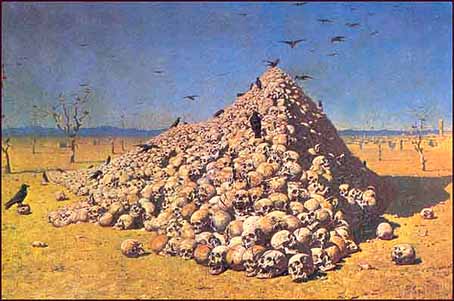
Russian painter Vassili Vereshchagin's "The
Apotheosis of War" (1871) was inspired by the conquests of Tamerlane,
but it came to be associated with the Russo-Turkish War of 1877-78. That is,
before the Armenians appropriated
the painting for usage as "Armenian genocide" evidence.
|
No. 65
(Telegram from Suleyman Pacha to His Highness the Grand Vizier, August 3rd 1877).
A Column of troops has been dispatched to day to Iflehanli. All the male population
of this village from 5 years and upwards and a certain number of women have been
massacred by the Bulgarians. The young women and girls were obliged to dress in the
Christian style and were then all carried away into the Balkans. The Imperial troops
found nothing in the village except young children and a few women in a state of
complete nakedness. Twenty five wagons were sent from headquarters, to take these
women and children to Haïn Keuy where they are now being cared for.
No. 66
(Telegram from Suleyman Pacha to His Highness Grand Vizier, August 3rd 1877),
Skirmishers forwarded towards Kezanlik encountered and attacked some Bulgarians near
the village of Maglass. The latter were defeated and fled to the mountains leaving
20 of their companions dead on the field. Our skirmishes then entered the village
and found about a hundred mussulman women and young children, who were brought to
head-quarters. Other women numbering to more than a hundred had been shut up by the
Bulgarians in a neighbouring convent. Our skirmishers after having received
reinforcements marched towards this convent to deliver them.
No. 67
(Telegram from Suleyman Pacha to His Highness the Grand Vizier, August 4th 1877).
A British Naval Captain who accompanied the Imperial army to Haïn-Boghaz went to
the village of Iflehanli where he saw the following:
A hundred and twenty mussulman inhabitants had been massacred in the most savage
manner by the Bulgarians and Cossacks. Amongst those who were dead we remarked a
young women of great beauty, who had been strangled and thrown into the water,
despoiled of all her clothes, the body of another woman was exposed in the open
street, many others were thrown into pits and wells. The same fate had befallen the
members of an entire family including even the children. The British officer
recognised from the richness of their dress that the victims belonged to notable
families. The Bulgarians and Cossacks had kept for ten days the wives of the
mussulman inhabitants whom they had massacred, as well as other young girls, and
inflicted upon them the greatest indignities, they then set fire to the dwellings
where they lived and left 15 persons to perish in the flames. The Bulgarians on the
arrival of the Imperial troops at Haïn-Boghaz fled towards the Balkans, carrying
with them all the women from 30 years of age and upwards, as well as many children.
The British officer saw the bodies of the victims of the Bulgarians and Cossacks,
they had been gathered together, placed in a line and then massacred. There were
many more cases of assassination but the British officer had no time to go and see,
as he had to return to headquarters. These sorrowful facts have also been witnessed
by Captain Fife, British Military attaché, and by the Correspondents of the Daily
Telegraph, Morning Post, and Times, who have respectively addressed a report to the
Embassy, and to their different journals.
No. 68
(Telegram from Captain Gambier R. N. to Mr. Austin Times Correspondent. Therapia,
August 4th , 1877).
The day before yesterday I accompanied the Ottoman army to Haïn Boghaz. Yesterday I
went to Iflehanli 2 ½ hours distance from the defile, I saw one hundred and twenty
persons massacred in the most savage manner by the Bulgarians and Cossacks. Amongst
those dead, were two women one of them young and of great beauty who had been
despoiled of her clothes, strangled and thrown into the water, the other was left
lying in the open street. There were many more who were thrown into wells. I saw
with my own eyes, the members of an entire family including the children who had met
the same fate. To judge from their embroidered dresses of good stuff, the victims
were well to do people. The wives of the victims and other young beauties were
locked up in a house, where the Cossacks and Bulgarians inflicted on them during ten
days the greatest indignities. According to information gathered from an old woman,
whom I met on the spot, they set fire to the house in which these women were, and
fifteen persons perished in the flames. Informed of the arrival of the ottoman army
at Haïn Boghaz the Bulgarians fled to the mountains, carrying with them all women
from thirty years of age and upwards. The victims of whom I have spoken above had
been gathered together ranged in a line and successively massacred. There were many
more persons killed, but I had no time to go and see them.
No. 69
(Telegram from Major Leader to Mr. Gay, Daily Telegraph Correspondent, Hôtel d’Angleterre
Pera, August 5th 1877).
Yesterday, I was at the neighbouring village of Iflehanli, accompanied by Captain
Fife, military attaché, and the correspondents of the Morning Post, and Times. I
saw in this place more than hundred and twenty bodies of mussulman men and women
whom the dogs were devouring, I also saw from five to ten bodies of girls thrown
into wells as also a young woman of great beauty strangled and thrown into the
water, despoiled of all her clothes. According to the assertions of an old woman who
was on the spot, the Cossacks and Bulgarians after having violated the young
mussulmans carried them away to the Balkans. The above is what I have seen.
Elsewhere according to positive information which I gathered, with the exception of
a few old women, all the mussulman population had been massacred, all the dwellings
burnt and all their goods pillaged. It results according to our information from the
survivors that these misdeeds were committed, at the instigation of the Russians, by
the Bulgarians and Cossacks. There is no doubt that the massacre was encouraged by
the Russians.
|
| |
No. 70
(Telegram from the Governor General (ad interim) of Adrianople to the Ministry of
Interior, August 5th , 1877).
I have the honor of transmitting to you the following telegram which I have just received
from the Governor of Pilippopoli. The Bulgarians met together in the villages of Melemez
and massacred seven soldiers. The assassins were attacked and defeated by the Imperial
troops. The mussulman inhabitants of Kara-Kilissa, a village situated about one hour’s
distance from Melemez, were locked up in a church by the Bulgarians. The massacring had
already commenced when the Imperial troops informed of the fact by several fugitives,
immediately marched to the spot and dispersed these rascals and delivered the inhabitants
of the village, and later on those of the village of Kutchuk Stinli. The enemy has
evacuated Kezanlik and retired on Chipka carrying away with him all the mussulman and non-mussulman
population.
The authorities are charged to take care of the cattle which had been abandoned.
No. 71
(Telegram from the Governor General (ad interim) of Adrianople to the Ministry of
Interior, August 6th 1877).
I am sorry to inform you that more than half of the Jewish inhabitants of Kezanlik men
women and children have been massacred by the Russians and Bulgarians.
A SERIES OF PRIVATE TELEGRAMS.
_______
No. 72
(Telegram from Mr. Gay to “Daily Telegraph,” London. Pera. 26th June, 1877.)
Chumla.—Five women and three children from the Tirnova district, wounded by the
Cossacks, arrived here last night. Mehemed Ali Pasha visited the refugees to-day.
No. 73
(Telegram from Mr. Huyshe to Mr. Bennett, London. Chumla, 1st July, 1877.)
It is reported that the country between Biela and Sistowa is the theatre of important
operations. The Bulgarians are in a disturbed condition pillaging Mussulmans.
No. 74
Translation.
(Telegram from Mr. Simon to Reuter’s Agency, London. Chumla, 1st July, 1877.)
Russians continue to bombard Roustchouk with inexplicable persistence. Principle buildings
are destroyed, amongst Consulates, Italian, Russian remain intact, the others are in
ruins; great desolation exists; the population is flying to Varna. Many families remain
without shelter; international telegraphic service is suspended at Roustchouk, service
Turk continues. The number of Russians at Sistowa is thirty thousand. The marching on
Biéla is arrested at Pavlo by Turks. No details of engagement. News from Dobrudja signal
cruelties committed by Russians on few Mussulman people; Turkish civil authorities have
evacuated Toultcha and are established at Medjidié.
No. 75
Translation.
(Telegram from Mr. Jacquot to “Journal des Debats,” Paris. Chumla, July 2nd ,
1877.)
Bombardment of Roustchouk continues; Consulates, Hospitals, ambulances, are complexly
destroyed; important military events are imminent on the river Jantra, which forms a good
line of defence. Authorities and Mussulman population are forwarded on Medjidié. Old
Mussulman men left to look after the harvest have been massacred and the farms pillaged by
Bulgarian brigands.
No. 76
(Telegram from Mr. Gay to “Daily Telegraph,” London. Pera, July 2nd , 1877.)
Soukoum-Kaleh, June 25. The Military Commissioner just returned from scenes of Russian
outrages, found whole districts destroyed and hundreds families destitute. Russians having
carried off everything, even bedclothes, owing to the pastoral habits of the people, it is
impossible to arrive at present at a just estimate of the damage done, still more dreadful
deeds are done in districts still held by the Russians, such as murders, outrages, and
cruelties. Every village in Zannis district burnt. 1,500 families starving in the valley
Ardlera, Fazli Pasha is sending up stores for their relief.
Soukoum-Kaleh, June 26 th . News just reached here that Fazli’s stores are useless for
Ardlera valley, as 1,500 families are all dead from starvation. Help too late. Russian
brutality triumphant.
No. 77
(Telegram from Mr. Barrère to “Guardian,” London. Chumla, July 3rd , 1877.)
Russian shells continue devastation in town. Today hospital and barracks were fired and
burnt to the ground. Turkish population of all the villages and towns down to Rasgrad
hurriedly evacuating towards Varna. Russians have not passed the Janta yet, but their
movements remain unknown.
No. 78
(Telegram from an official person to another official person, London.) Constantinople,
July 3rd , 1877.)
As notwithstanding the promises given me, that gentleman is not apparently allowed to
telegraph, I have no trust-worthy news from the seat of war in Asia; according to a
telegram just received by the Porte, the Turkish troops have had four engagements with
Russians near Alasguerd, two of which were serious; the Russians are stated to have been
driven back by Karakilissé with considerable loss. Troops are being hurried up to Sofia;
twenty-five battalions have just left for that place. Fresh reports are current of
massacres of Mussulmans by Bulgarians.
No. 79
(Telegram from Mr. Gay to “Daily Telegraph,” London. Pera, July 4th , 1877.)
At Sistowa the Bulgarians massacred many Turkish women and children. Turks terribly
exasperated, they say children were thrown from windows into the street.
|
|
No. 80
Translation.
(Telegram from Mr. Jacquot to Mr. Bennett, London. Chumla, July 4th , 1877.)
Russians have burnt the village of Maratin, ten kilometres from Rustchouk.
No. 81
(Telegram from Mr. Gay to “Daily Telegraph,” London. Pera, July 5th , 1877.)
My previous telegram respecting the murders of Turkish women and children at Sistowa
is correct in every detail. It is certain also that Bulgarians whenever able fire
upon retiring Turks. These new Bulgarian atrocities committed by Christians upon
Turks surely have fearful effects. Already the Turks are naturally exasperated and
likely make reprisals.
No. 82
Translation.
(Telegram from Mr. Sumony to Reuter’s Agency, London. Chumla, July 5th , 1877.)
Confirmation of massacres of Mussulman families of Sistowa and the pillaging of
dwellings by Bulgarians encouraged by the Russians. Eight Turkish soldiers
stragglers have been massacred by strokes of the stick. The attempt of the
Bulgarians to burn the magazines of Roustchouk has been frustrated. No news of the
war.
No. 83
(Telegram from Mr. Huyshe to Mr. Bennett, London. Chumla, July 5th , 1877.)
Fugitives arrived confirm the atrocities committed by the Bulgarians upon Mussulmans
and Jews at Sistowa. Several of the latter were murdered, the Turkish women were
thrown into the river.
No. 84
(Telegram from an official person to another official person, Constantinople.)
Trebizond, July 5th , 1877.
From newspaper correspondents, dated 26 th ult. from Soukoum, states that Russian
atrocities are reported at Ardlera, north of Soukoum. One thousand five hundred
families are reported to have died of starvation being forced to fly into the
forests to escape the Cossacks, who burnt and pillaged all before them.
No. 85
Translation.
(Telegram from Mr. Jacquot to “Journal des Débats.” Paris. Chumla, July 5th
, 1877.)
The Bulgarians are massacring the Mussulman fugitives from Sistowa and are pillaging
the houses. They assassinated with sticks eight soldiers stragglers. The Bulgarians
have tried to set fire to the Government magazines at Roustchouk. Suspected
Bulgarians will probably be sent to the fortresses on the Danube.
No. 86
(Telegram from Mr. Fitzgerald to “Standard,” London. Chumla, July 5th ,
1877.)
Additional details have come to hand of the massacres at Sistowa of eight soldiers
straggling in town and killed by blows from sticks, in presence of the Russians. The
attempt of some Bulgarians to blow up the magazines at Roustchouk, has failed.
No. 87
(Telegram from Mr. Coningsby to Mr. Donald, Times Office London).
Chumla, July 5th 1877.
Arrangements by which independence in writing secured on good terms now with
authorities; wild stories of massacres by Bulgarians current here, cannot find
substantiation so refrain. No news here, I interpret as bad news.
No. 88
(Telegram from an official person to another official person. London)
Pera, July 6th , 1877.
A person from Trebizond telegraphs that a private letter to him, dated Soukoum-Kaleh,
26 th ult., not from a newspaper correspondent, states that Russian atrocities are
reported at Ardlera, north of Soukoum, where fifteen hundred families are reported
to have died of starvation, being forced to fly into the forests to escape the
Cossacks, who burnt and pillaged all before them.
No. 89
(Telegram from Mr. Gay to “Daily Telegraph,” London. Pera, July 6th , 1877.)
Ardanoush via Batoum.—Thursday morning.—Russians flying everywhere, after having
reduced the town and district to a desert. Terrible cruelties reported; Russians
massacred Turks in great numbers during their advance.
|
| |
No. 90
(Telegram from Mr. Gay to “Daily Telegraph,” London. Pera, July 6th , 1877.)
Tirnova.—Thursday night.—Russians are advancing and the Turks are concentrating in
great force. The Bulgarians massacre Turkish women, children, and old men, wherever the
Russians come. These horrible deeds and cruelty likely someday to lead to vengeance. The
Russians encourage the Bulgarians to exterminate the Turks.
No. 91
(Telegram from Correspondent to “Observer,” 170, Strand, London.)
Pera, July 7th , 1877.
Russian atrocities reported in the neighbourhood of Soukoum. Many families, flying from
the Cossacks, taken refuge in the forests, where they have died from starvation.
No. 92
Translation.
(Telegram from Mr. Bordéano to Mr. Chambers, “Morning Advertises.” London. Pera,
July 7th , 1877.)
Since yesterday there has been a combat at Sistowa of which the result is yet unknown. By
the Sultan’s order, Circassians and Zeïbecks quit Constantinople. At Ipek-Guedighi the
Turks discovered, in a Church, ten Mussulman and Christian bodies, assassinated by the
Russians.
No. 93
(Telegram from Mr. Hanly, to “Telegraph,” Newspaper, Sheffield. Pera, July 8th ,
1877.)
After three hours combat at Utch-Kilissa, Russians pillaged the Church, fired the houses,
and maltreated and carried off the Armenian Bishop.
No. 94
Translation.
(Telegram from Mr. Lascary to Reuter’s Agency, London, Erzeroum, July 8th 1877.)
In the Church of Utch-Kilissa ten bodies have been discovered. The investigation has
commenced in the villages. The Armenian Church is burnt.
No. 95
(Telegram from Mr. Hanly to the “Morning Advertiser,” London. Pera, July 9th ,
1877.)
Chumla.—Sunday morning.—The evacuation of Biéla was a strategical measure. The
bombardment of Roustchouk has ceased. Turkish quarter, the Government buildings and
hospitals have been destroyed, and the Bulgarian quarter damaged. Small shells having fell
the inference is that Russians have removed their heavy guns probably to Silistria. This
week is expected to be decisive. Execution of Turkish plan awaited confidently.
No. 96
Translation.
(Telegram from Mr. Schluga to Mr. Etienne, Vienna. Erzeroum, July 9th , 1877.)
The Russians, after the engagement at Ardanoush, on the 28 th June, completely plundered
the villages of Ardanoush, Chaters, Longots, and Gulsen; they killed and massacred more
than fifty men, women, and children, in the villages of Chano, Chrawal, Unisli, Dsidsigil,
Alhascheir, Charters, Sichia, under the pretext that they had borne arms against them.
No. 97
Translation.
(Telegram from Mr. Simony to Reuter’s Agency, London. Chumla, July 9th , 1877.)
At Tirnova, the Russians burnt five villages; at Monastir they massacred forty private
individuals, including women and children.
No. 98
(Telegram from Mr. Hanly, Pera, to the “Morning Advertiser,” London. July, 10th
1877.)
The Russians burnt five villages between Selvi and Tirnova; they massacred at Monastir
forty inhabitants, including women and children.
No. 99
(Telegram from Mr. Thomas to the “Morning Post,” London. Pera, July 9 th , 1877.)
Before retiring from before Kars, the Russians accusing two neighbouring villages of their
women, stripped them naked and flogged them nearly to death with the knout. I send the
details by letter.
|
|
No. 100
(Telegram from Mr. Buckland to “Norma”, Edinburgh. Pera, July 10th , 1877.)
Between Selvi and Tirnova, the Russians burnt five villages; they massacred at
Monastir, forty civilians including women and children.
No. 101
Translation.
(Telegram from Mr. Jacquot, at Osman Bazar, to “Débats,” newspaper, Paris.)
Chumla, July 11th , 1877.
The whole Mussulman population emigrates. As soon as Russians arrive, the Bulgarians
plunder and burn the Turkish houses and massacre those who have remained behind. I
have heard in person dreadful tales from the refugees of the seven villages of Batak,
Diskat, Neddan, Visuli, Jaideli, Trenibeck, Frenchi, and Issari, which were set fire
to. The Government feeds between Osman Bazar and Eski Djouma ten thousand families
of refugees with their herds. It is a painful sight.
No. 102
(Telegram from Mr. Gay to the “Daily Telegraph,” London. Pera, July 11th ,
1877.)
Russians inciting the peasants everywhere to commit horrible atrocities on the
remaining Turks, specially in the district of Tirnova.
No. 103
(Telegram from Mr. Gay to the “Daily Telegraph,” London. Pera, July 13th ,
1877.)
Adrianople.—Friday.—The Bulgarians are massacring the Turks in Balkans by
wholesale, men, women, and children alike, the Russians having given them arms.
No. 104
Translation.
(Telegram from Mr. Barrère at Osman Bazar, by Chumla, to the “Republique
Française,” newspaper, Paris.)
Chumla, July 13th , 1877.
The evacuation of Tirnova by the troops and the Mussulman population is to-day an
accomplished fact. Turks have been obliged to retire on the Osman Bazar road before
superior forces. The Turkish population is encamped along the roads, the Turkish
houses having been burnt after their departure and the aged who remained
slaughtered.
No. 105
Translation.
(Telegram from Mr. Englander to Reuter’s Agency, London. Pera, July 13th ,
1877).
Numbers of Mussulmans, women and children, flying before Russians, have been killed
by the Bulgarians in the defile of Haïn Boghaz, between Tirnova and Kezanlik.
No. 106
Translation.
(Telegram from Mr. Englander to Reuter’s Agency, London. Pera, July 13th ,
1877.)
Everywhere the mussulmans quit their villages on the approach of the Russians, and
the Bulgarian Christians pillage and burn their dwellings.
No. 107
(Telegram from Mr. Gay to the “Daily Telegraph,” London. Pera, July 13th ,
1877).
Roustchouk, July 19 th , night. The Russians and Bulgarians are committing terrible
atrocities on Mussulmans, butchering both sexes, sparing none.
One instance of this, a man was found dead with a child in his arms, the baby having
two bayonet wounds.
These acts certain to evoke terrible reprisals.
No. 108
(Telegram from Mr. Borthwick to Mr. Borthwick, “Morning Post,” London.)
Chumla, July 13th , 1877.)
At Tchairly, a district of Rasgrad, two hundred mussulman refugees from Sistowa were
massacred by the Russians and Bulgarians; at Kara-Tchoumak ten carts full of
refugees of Arnoutlou massacred; at Arnoutlou also, even women and ten children; at
Utch-Destin, the whole population have been killed; at Ostrantcha and Costova, four
hours from Roustchouk, the whole Mussulman population, including thirty-five
children; at Keston and Zalvate, a district of Tirnova, the Bulgarians excited,
massacred the Mussulman population; at Zalva and Dobnitza the Mussulmans were killed
by the Bulgarians; on the Balkans, near Kayne, at Besphina, the Russians took the
whole population prisoners, and violated all the women.
|
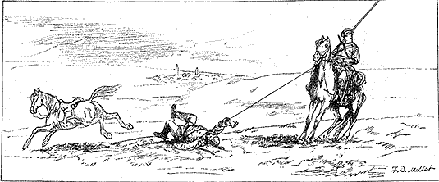
Frank Millet was an illustrator and war correspondent; he joined
the Cossacks during this 1877-78 war, and his two illustrated
"Campaigning with the Cossacks" articles were published in
Harper's New Monthly Magazine (January 1887, February 1887
issues). Millet's description for the above: "One fat Turkish
officer on a pony much too feeble to carry the weight on his back
made frantic endeavors to escape, and one of the major's orderlies
started in sharp pursuit. . . but instead of drawing his carbinehe swung
his lariat around his head in true Mexican style, lassoed the Turk,
and dismounted him. The pony was left for me to catch. . . ."
Millet died on the Titanic; two more illustrations will follow, below.
Thanks to Paul Giambarba's site. |
No. 109
(Telegram from Mr. Dow to “Dundee Adviser,” London.)
Chumla, July 13th , 1877).
Accounts received here state that Russians are behaving with excessive brutality towards
the Turkish population; two hundred persons of Tchairly, Rasgrad district, have been
massacred; eleven women and ten men have been murdered at Kara-Tchoumak, near Tirnova.
Russians have occupied the villages called Ostrantcha and Costova, four hours from
Rustchouk, massacring the children and violating the women.
No. 110
(Telegram from Mr. Crespin to “Observer.” London. Pera, July 14th, 1877.)
The Bulgarian and Russian atrocities against inoffensive Mussulman men, women, and
children, have this day occupied the Porte, which is preparing diplomatic memoire. After
accomplishing this hideous and sanguinary task the Christian Bulgarians, surviving, are
forcibly enrolled in Bulgarian corps by the Russians and the least resistance is punished
by death. Roumanian journalists are ordered by Russians to cite similar atrocities
committed against Christians by Turkish soldiers. Be positive these accusations are
expressly exaggerated to deceive Europe.
No. 111
(Telegram from Mr. Gay to “Daily Telegraph,” London.)
Pera, July 14th , 1877.
Yesterday I saw villages blazing near Vetova. I spoke with Circassian scouts, who told me
that the Bulgarians were joining the enemy everywhere, that the Russian infantry and
Cossacks were massacring Turkish villagers, all round, especially at Dikili-Tash, near
Roustchouk. Cossacks marching towards Rasgrad are within three hours of that town. The
railway probably is cut now. I now give the list of villages in which I know massacres
absolutely to have happened.
Beshpunar village, all the prisoners were killed and the women violated. Tchairly, in
Rasgrad district, two hundred refugees from Sistowa all put to sword; at Kara-Tchoumak
village, ten cartloads of refugees from Arnoutlou were killed.
At Unt-Deitan, all the people of the village have been murdered. At Ostrantcha and Costova,
four hours from Roustchouk, all the Mussulmans, among whom thirty five children, were
butchered.
At Kestan and Selvan, in Tirnova district, the Russians incited the Bulgarians to murder
the Mussulman refugees from Selvi and Dobrudja and the miserable people were all killed
near Khayn. These are exact statements and cry fury amongst the Turks, the result this
wholesale butchery helpless.
No. 112
(Telegram from Crespin to “Observer.” London. Pera, July 14 th , 1877.)
Mussulmans are abandoning the villages and cities occupied by Russians in Bulgaria. The
Bulgarians are making use against Mussulmans of all ages, including women and children.
These atrocities are committed before and ordered by Russians, whose officers taking
advantage of such shameful atrocities, violate Turkish girls and women, before exposing
them to being assassinated. Most decidedly such barbarous acts surpass the supposed
cruelties of last year. This information was telegraphed last night and this morning to
several foreign embassies and many correspondents.
No. 113
(Telegram from Mr. Gay to “Daily Telegraph,” London.)
Pera, July 14th , 1877.
There can be no doubt of the Bulgarians perpetrating wherever Russians come most horrible
barbarities upon mussulman population. From every direction fugitives have arrived,
bringing with them narratives of terrible deeds, of the slaughter of men and children, and
the violation of the women. These stories are abundantly confirmed. It is quite certain
that some hundreds unfortunate persons have been killed in various villages between
Sistowa, Monastir and Tirnova. This is not exaggerated, every word is exact truth.
No. 114
(Telegram from an official person to another official person, London)
Pera, July 14th , 1877.
A gentleman states that the Governor-General of Adrianople informs him that the Russians
have established a head military tribunal at Selvi, for trial of the Mussulmans alleged to
be implicated in the Bulgarian insurrection of last year, that the Bulgarians are invited
to denounce Mussulmans, who are at once shot or hanged, and that the Russians are
committing great barbarities on the poor defenceless Mussulman inhabitants of that part of
the country.
No. 115
(Telegram from Mr. Fitzgerald to the “Standard,” London.)
Chumla, 15th July 1877.
Details of Russian atrocities have been received which are worse than early telegrams
indicated, thousands of unarmed men, women and children who left the villages of the
districts of Sistova and Tirnova, before the Russian occupation, and who took refuge in
the villages in the district of Rasgrad Osman-Bazar, have been set upon by Cossacks and
Bulgarians, numbers have been massacred, others driven back into Russian zone, probably to
share the same fate, some few escaped. Bulgarians in parts occupied by the Turks are
fearing retaliation, matters becoming critical.
No. 116
Translation.
(Telegram from Mr. Erlanger to Reuter’s Agency, London.) Constantinople, 15th July
1877.)
An Embassy has received Consular reports from Bulgaria establishing the fact of the
atrocities perpetrated against the Musulmans.
No. 117
(Telegram from Mr. Simon to Reuter’s Agency, London.)
Chumla, 15th July 1877.
The Russians continue their atrocities against the Musulmans.
No. 118
(Telegram from Mr. Austin to the “Times,” London.)
Therapia, 15th July 1877.
It is reported that Russians established a military tribunal at Selvi to try Mussulmans
accused of implication in the Bulgarian massacres and have executed men, convicted on
Bulgarian testimony. The Russians and Bulgarians are accused of committing barbarities
against defenceless Mussulmans, even against women and children near Kustendjé and also
Tirnova.
No. 119
(Telegram from Mr. Buckland to the “Norma,” Edinburgh.)
July 15th , 1877.
Mr. Drummond telegraphs from Chumla, that at Tchairly, district Rasgrad, two hundred
Mussulman refugees from Sistowa have been massacred by Russians and Bulgarians. At
Karatchoumak ten cart-loads of Arnoutlou refugees have been massacred, at Arnoutlou
numbers of women and ten children; at Utch Testin whole population killed; at Ostrantcha
and Costova all Mussulmans including thirty-five children; at Kestan and Yelcan Bulgarians
incited by Russians massacred Mussulman population; at Galva and Dobnitza all Mussulman
population killed by Bulgarians; in the Balkans at Beshpunar Russians took whole
population prisoners, and violated all women.
|
|
No. 120
(Telegram from Mr. Gay to the “Daily Telegraph,” London.)
Pera, July 15th 1877.
Chumla, Saturday, midnight. Refugees from Sistowa and surrounding villages to the
number of three thousand were assailed by Russians in the district of Tchairli. Part
were massacred and part taken to Testrenik, where outrages were committed on Turkish
women.
No. 121
(Telegram from Mr. Hanly to the “Morning Advertise,” London.)
Pera, July 15th 1877.
No news from the Danube except of massacres by Bulgarians, at Russian instigation,
of Mussulman fugitives from Sistowa, and of men, women and children inhabitants of
places now unprotected by Turkish troops.
No. 122
(Telegram from Capt. Gambier to the Editor of the “Times,” London.)
Pera, 15th July 1877.
I have just come from the Palace and have received most positive assurances from the
Sultan himself of the truth of the massacres of Turkish population by Bulgarians.
Russians are disarming Turks and arming the Bulgarians; the women are violated and
the children killed and the villages burnt by them. The Sultan expressly desired me
to be informed, that 500 refugees arrived in Stamboul yesterday, many with their
hands cut off. The Turkish Balkan population is houseless and starving.
No. 123
(Telegram from Mr. Gay to the “Daily Telegraph,” London.)
Pera, July 16, 1877.
The Russians have established a mock tribunal at Tirnova, and are shooting great
numbers of Turks, awful butcheries, in the villages of Yelcan and Kestan.
Chumla, Sunday night.—Five thousand wagon loads of terror stricken Turkish old
men, women, and children are on their road from Djuma and Osman Bazar to here.
Horrible massacres are committed by the Bulgarians and Russians at Tirnova, Gabrova,
and Slena. I saw refugees myself; I will send you statements.
No. 124
(Telegram from Mr. Scaife to the “Guardian,” London.)
Pera, July 16th , 1877).
Further atrocities are reported of the Russians in the Tirnova and Plevna districts.
Seven Turkish villages of these localities were given to flames and the inhabitants,
men, women and children, were murdered in cold blood.
No. 125
(Telegram from Mr. Chatau to Correspondenz Bureau, Vienne.)
Pera, July 16th , 1877.)
Excesses against all Mussulmans are committed, principally by Bulgarians, to whom
Russians give arms. Russians are forming the Bulgarians into battalions.
No. 126
(Telegram from Mr. Gay to the “Daily Telegraph,” London.)
Pera, July 16th , 1877.
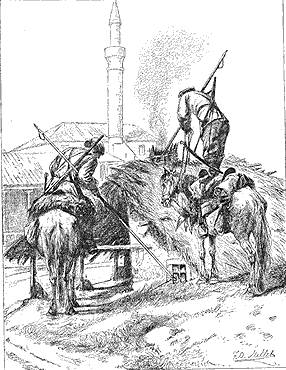 |
|
Cossacks
use their lances to search for Turks hidden
in their dwellings, while raiding a village. The
illustration is by Frank Millet, for Harper's (see
above). Wonder if Millet showed sympathy for
Turks in his articles? From the few excerpts available,
he appears to have grown very friendly with the
Cossacks, so maybe the Turks were just "things"
to be dug out. Perhaps the Cossacks were on better
behavior, knowing there was an American
journalist among them. Who knows. |
Chumla, July 16th , 1.40, p.m. – I have just
seen wounded refugees from villages of Heibeli, have been in their houses, have
spoken at length and made strict inquiry, accounts agree perfectly in all details
with those of yesterday. On Wednesday, July 11 th , the villagers of Heibeli, in
company with those of many other villages were attacked between Tchairkeui and
Kogia-Pounar, by six hundred Cossacks. Heibeli consists of six hundred inhabitants;
the women and children were massacred, carts fired at by three field guns; not a
single cart was saved and the villagers have not saved a single thing, not even
clothing. In the first house I entered one women had one sword cut on the head and
one on the wrist and two lance wounds, one of which is left breast. A child of six
years had a lance wound in chest. Eleven people were in the first house. In the
second house one boy eight years old had a lance wound in the thigh, which went
right through, one woman had fourteen lance wounds all over her body and a sword cut
over her hand; another woman one deep lance wound in her back and four in different
parts of her body and two in her breast; one boy of five years old had a lance wound
in his thigh; a girl four years old had a lance wound in her back; she was an
orphan, her uncle, her only support and his little daughter were killed. Twenty-one
people in the second house. I saw the wounds myself. Heibeli is in the district of
Sistowa, one hour’s distance on the other side of the Jantra river. Among
villagers were also thirty-five Tartar families, these escaped. The attack commenced
at daylight; all villagers have not yet come in, I am now going out to meet these
villagers Kogia-Pounar was burnt in this attack. From what I understand no
Bulgarians were concerned, only Cossacks.
No. 127
(Telegram from Mr. Gay to the “Daily Telegraph,” London. Pera, July 16th ,
1877).
Adrianople, Sunday night.—The Bulgarians armed by the Russians are committing
atrocities everywhere. The Russian force at Bebrova is five thousand, amongst them
is one battalion of Bulgarians equipped with arms taken from Turks; the Russians are
marching on Kazan.
No. 128
(Telegram from Mr. Borthwick to the “Morning Post,” London.)
Chumla, July 16th , 1877).
The Russian atrocities continue. In the district of Tirnova the Russians made the
Mufti (judge) write to the villagers to keep quiet, the Russians being peaceful, the
Bulgarians were then allowed to massacre the Mussulmans; the Mufti having
remonstrated was hacked to pieces. I will send details by letter.
No. 129a
(Telegram from Mr. Barrère to “Guardian,” London. Chumla, July 17th , 1877.)
The Russian atrocities continue. In the district of Tirnova the Russians made the
Mufti (judge) write to the villagers to keep quiet, the Russians being peaceful, the
Bulgarians were then allowed to massacre the Mussulmans; the Mufti having
remonstrated was hacked to pieces. I will send details by letter.
No. 129b
(Telegram from Mr. Barrère to “Guardian,” London. Chumla, July 17th , 1877.)
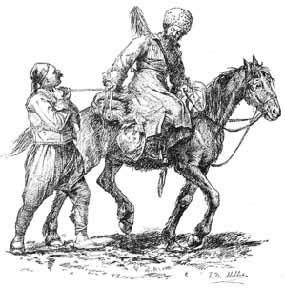 |
|
Millet's
illustration of the capture of a Turkish
officer by a Cossack. |
I have seen Turkish victims of the Cossacks
picked up and carried to Rasgrad; as there is no hospital, the wounded were
distributed in private houses; I counted among them 14 women and children and two
old men. One girl, five years old, presented a ghastly sight, she was literally
covered with lance thrusts and sabre-cuts; another two years old had three wounds on
the head and body, one old woman had a bullet wound and three sword-cuts in her
body, four other children under twelve years were badly wounded; the children are
the worst treated. All the victims were natives of Ablanova. In the neighbourhood of
Roustchouk; the survivors say that many more women and children were slain. I have
seen girls and boys brought back motherless. More wounded are coming in and there
are many men yet to be picked up. It is reported that several hundred Turks have
fallen victims. A Turkish villager from Balvan here, says he is the sole survivor,
all Mussulmans having been killed by the Cossacks, after laying down their arms.
These facts have caused a profound impression amongst the Mussulmans.
|
| |
No. 130
Translation.
(Telegram addressed to Mr. Stephanopoulo at Athens by Mr. Zipcy.)
Pera, July 17th , 1877.
The atrocities and ravages by the Russians in Bulgaria are causing general indignation.
No. 131
(Telegram from Mr. Coningsby to Mr. Mc Donald, Times Office, London).
Chumla, July 17th , 1877.)
From cross examination of six wounded female victims, they declared that the Cossacks in
their barbarity near Sistowa have burnt women and that children were butchered by them. I
was slow to believe such senseless barbarism, but I find it too true. I arrived here from
the front yesterday.
No. 132
(Telegram from Capt. Gambier to the Editor of the “Times,” London.)
Adrianople, July 17th , 1877.
They assure me that several wounded and mutilated women arrived here last night, these
were Bulgarian victims. The Bulgarians have intercepted a field gun between Yeni-Zaghra
and Kezanlik; in Schipka fighting is going on. A train of wounded arrived here last night,
I met then jolting along the rough road in a burning sun, in uncovered carts and the roads
lined with refugees. I am going on to Yeni-Zaghra with a military train.
No. 133
Translation.
(Telegram from Mr. Jacquot to the “Journal des Débats.” Paris.)
Chumla, July 17th , 1877.
Rasgrad – I visited to-day fifteen wounded survivors of the Mussulman population of the
village of Ablanova, massacred by the Cossacks; four children under five years, five women
and six peasants, pierced by numerous sabre-cuts, of lance thrusts and by bullets. The
Mussulman population of the village of Balvan has been entirely massacred. On all sides
fugitives arrive announcing fresh massacres. No reprisals on the part of the Mussulmans.
No. 134
(Telegram from an official person to another official person, Constantinople.)
Philippopoli, July 18th , 1877.
Complete panic among the Turkish population here. This morning, owing to a report that
Russians have taken Kezanlik and that a body of them are marching here from Carlowa, most
of the officials and upwards of a thousand persons, chiefly Turkish women and children,
flocked to the railway station with their goods, but the mutessarif put a stop to their
departure. the panic has now diminished in consequence of assurances given by the Consular
corps to a deputation of leading Turks that the Russians would molest no peaceable
persons. The situation is still rather critical, however, Turkish lower orders are all
openly armed, fearing a Bulgarian rising. Austrian, French, and Greek consuls will
presently call in a body, on the mutessarif to urge the formation of a mixed police force
of civilians, and the disarmament of the population at large.
No. 135
(Telegram from Mr. Fitzgerald to the “Standard,” London. Chumla, July 18th , 1877.
The Mussulman inhabitants of the village of Bellina, near Tirnova, took refuge in the
mosque. On the approach of the Russians, they sent to the Russian commander and said they
placed themselves under his protection; he replied that they had to suffer for last year’s
doings and ordered fire to be set to the mosque; all inside were burnt, only three
Mussulmans of the village escaped.
No. 136
(Telegram from an official person to another official person, London.)
Pera, July 18th , 1877.
A person informs me that the Turks have evacuated Kustendjé, which has been occupied by
the Russians. The Bulgarians appear to be committing excesses in the town and the
neighbourhood.
No. 137
(Telegram from Mr. Gay to the “Daily Telegraph,” London.)
Pera, July 18th , 1877.
The reported massacre here by bashi-bozouks is un-true. I made a house to house
inspection, I found no dead bodies; only four Bulgarian houses have been burnt; the church
and school are intact; two mosques and 30 Turkish houses have been burnt, found evidences
of Bulgarian plundering. When the Russians were near the town horrible outrages by
Bulgarians were committed everywhere. I saw three women whose husbands were cut to pieces
before their eyes. At the village near here, all the women and children were shut up in
the mosque and burnt alive, their husbands being away as bashi-bozouks. Dreadful stories
everywhere. The Turks on contrary allowed all Christian families to retire.
No. 138
Translation.
(Telegram addressed to Mr. Etienne at Vienna by Mr. Zipcy.)
Pera, July 18th , 1877.
The report of the British Consul at Selimno mentions the atrocities of the Bulgarians
against the Mussulmans. He draws attention to inevitable reprisals.
No. 139
Translation.
(Telegram from Mr. Englander to Reuter’s Agency, London.) Constantinople, July 19th ,
1877.)
The Turkish population of the interior is greatly excited in consequence of the Bulgarian
atrocities.
|
|
No. 140
(Telegram from Mr. Gay to the “Daily Telegraph,” London. Pera.
19th July, 1877.)
Kars, Thursday.—Moukhtar Pasha is doing utmost to restrain Kurds from pillaging
and killing Russian sympathisers, but unable wholly to prevent outrages because of
the determination of the Turks to have revenge for the atrocities committed by
Russians in Asia during advance. Enemy has retreated all along the line over the
frontier, leaving country lately occupied desolate.
No. 141
(Telegram from Mr. Fitzgerald to the “Standard” London.)
Chumla, July 19th , 1877.
I saw several new cases of wounded fugitives today, one infant ten months old had
three lance wounds. Crowds continue coming in before advancing Russians, who are
committing the grossest cruelties on Mussulman population.
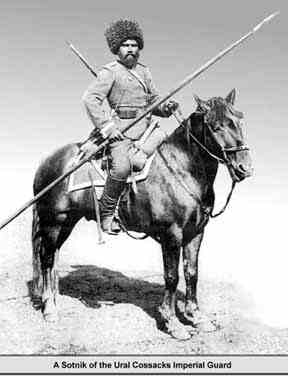
Cossack with lance. Notice the sharp point.
How brave of him to stick it into babies.
No. 142.
Translation.
(Telegram from Mr. Schnieder to Mr. Dumont, Cologne.)
Pera, July 19th , 1877.
The Bulgarians of Kustendje, after the departure of the Turks, attacked the mosques,
&c. The Greek Archbishop had to invite the Russians to occupy the town to guard
the public interests.
No. 143
(Telegram from Mr. Gay to the “Daily Telegraph,” London.)
Pera, July 19th , 1877.
Tarparese.—The inhabitants are leaving the country desolated by Russians, to
escape famine and other evils of war.
No. 144
Translation.
(Telegram from Mr. Chatau to Havas Agency, Paris.)
Pera, July 20th , 1877.)
Fresh atrocities committed by Cossacks and Bulgarians are reported in Bulgaria and
Thrace.
No. 145
(Telegram from Mr. Hanly to the “Morning Advertiser,” London.)
Pera, July, 20th 1877.
I continue to receive reports of Russian and Bulgarian atrocities. At the village of
Bulbuli, Turkish women and children fell victims; at Yabro and at Dobnitza all but
twelve were killed by Bulgarians; 5,000 refugees are at Djouma. The Cossacks have
slaughtered entire population of Ostrancha and Costovo. In the district of Tirnova
they ordered the people to renounce allegiance to the Sultan and openly encouraged
the Bulgarians to plunder and massacre. I have visited at Chumla 60 women and
children victims in a pitiable state.
No. 146
(Telegram from Mr. Fitzgerald to the “Standard, London.)
Chumla, July 21st , 1877.
The British Consul at Roustchouk and the French military attaché, Captain de Torcy,
visited numbers of wounded women and children of all ages from eight months, victims
of Russian barbarity. They report this information to their respective Governments.
No. 147
(Telegram from Mr. Crespin to the “Observer,” London.)
Pera, 21st July, 1877.)
On false reports of the Russians having defeated the Balkan army and were advancing
towards Philippopoli, awful fright occurred, Christian and Mussulman populations
were afraid of each other. Consular body there, (deprived naturally, of their
Russian colleague exciting the Bulgarians against Mussulmans), managed to restore
confidence and establish a national guard for protecting the town.
No. 148
(Telegram from Correspondent to the “Observer,” London.) Pera, July 5th ,
1877.)
A collective message, signed by all the foreign correspondents at Chumla, and
addressed to the Turkish Foreign Office confirms the atrocities committed by
Russians and Bulgarians.
No. 149
(Telegram from Mr. Barrère to the “Guardian,” London.)
Chumla, July 21st 1877.
More Turkish victims of the Cossacks have been brought here. Mr. Reade, the English
Consul at Roustchouk, and Captain de Torcy, the French military attaché, visited
to-day 20 women and children, amongst whom were two babies respectively aged eight
and ten months.
|
| |
No. 150
Translation.
(Telegram from Mr. Jacquot to the “Journal des Débats,” Paris.)
Chumla, July 21st 1877.
A process verbal, signed by 19 representatives of the foreign newspapers, proves the
atrocities of the Russian soldiers towards the Mussulman population. The Turkish Embassy
will communicate the document. Mr. Reade, the English Consul at Roustchouk and Captain de
Torcy, the French military attaché, have to-day visited the victims of the cruelty of the
Russians.
No. 151
(Telegram from Mr. Gay to the “Daily Telegraph,” London.)
Pera, July 22nd , 1877.
The Mussulmans sent ten parlementaires with a white flag, the Bulgarians massacred eight
and two escaped to Philippopoli. The fate of the inhabitants of Soungourlou is unknown but
certain. Sunday afternoon—The Russians are expected to arrive at Eski-Zaghra this
evening, the insurgents are committing barbarities on the road.
No. 152
(Telegram from Mr. Fitzgerald to the “Standard,” London.)
Chumla, July 22nd , 1877.
Namyk Pasha, accompanied by Captain de Torcy, French military attaché were engaged to-day
in distributing relief to refugees from Russian barbarity. It is reported that the
Nicopoli garrison is withdrawn. The Russian attack on the outworks of Silistria and Widdin
has been repulsed. His Highness the Grand Vizier has telegraphed the thanks of the
Government to the representatives of the foreign press, who signed the memorandum on the
Russian atrocities.
No. 153
(Telegram from Mr. Hanly to the “Morning Advertiser,” London.)
Pera, July 22nd 1877.
The European correspondents at Chumla have signed a report to the Ambassador, confirming
the Russian atrocities.
No. 154
(Telegram from Mr. Austin to the “Times,” London.)
Therapia, July 22nd 1877.
The Porte has telegraphed to its representatives at the foreign Courts that numerous
correspondents of the principal newspapers have signed circular that they have seen with
their own eyes Mussulman women and children with wounds caused by lance thrusts, who gave
them heartrending accounts of their barbarous treatment by the Russians and Bulgarians.
The Porte has received a telegram that the Russians have armed the Bulgarians, who are
killing the Mussulmans. This telegram is supported by a private English letter.
No. 155
(Telegram from Mr. Dymon to the “morning Advertiser,” London.)
Chumla, July 22nd 1877.
Further atrocities at Tirnova on women and children are said to have taken place.
No. 156
(Telegram from Mr. Scudamore to the “Standard,” London.)
Pera, July 22nd 1877.
Sunday afternoon.—Yesterday morning His Highness the Grand Vizier received by telegraph
from Chumla a procès verbal, which has been drawn up and signed by about twenty newspaper
correspondents, who are assembled in Chumla and who confirm the reports of the cruelties
committed on inoffensive Mussulman fugitives by the Russians and Bulgarians.
The correspondents, who represent the principal journals of Europe testify that almost all
the wounds inflicted on the fugitives, and especially on the women and children, have been
inflicted by the lance or sabre.
The Porte communicates this procès verbal to its representatives in Europe. The Porte has
addressed a dispatch to the President of the Swiss Republic, in which it complains of the
continual infraction by the Russians, of the terms of the Treaty of Geneva.
In this dispatch the Porte, also, complains of the cruelties committed by the Russian
troops, which are contrary to the spirit, even if they are not opposed to the letter of
the Geneva Convention.
No. 157
Translation.
(Telegram from Mr. Englander to Reuter’s Agency, London.)
Constantinople, July 22nd 1877.
Consul Blunt telegraphs from Kezanlik to Mr. Layard that the Cossacks disarm the Mussulman
inhabitants and the arms are given to the Bulgarians, who are outraging the women and
children. Mr. Layard has sent a proof of the atrocities to Lord Derby. The Porte has
received a telegram from Chumla, dated July 20 th , bearing the signatures of 22
correspondents, of whom the correspondents of Débats, Post, Times, Telegraph, Manchester
Guardian, Examiner, New York Herald, and Gazette de Cologne have seen with their own eyes
women and children wounded by lances and sabres. The Cossacks have committed many other
terrible atrocities.
No. 158
Translation.
(Telegram from Mr. Englander to Reuter’s Agency, London.) Pera, July 23rd 1877.
Philippopoli 22 nd .—The Russians everywhere shoot the authors of the past massacres in
Bulgaria, of whom they have a list.
No. 159
(Telegram from an official person to another official person, Constantinople.)
Chumla, July 23rd 1877.
The arrival of the new Commander-in-Chief yesterday has had a very good effect. I am
inquiring and examining victims of the enemy’s atrocities.
|
|
No. 160
(Telegram from Mr. Schuver to the “Standard,” London.)
Adrianople, July 23rd , 1877.
The Bulgarians burned two mosques and fifty houses at Eski-Zaghra. Excesses against
the Mussulman villages of districts Kezanlik and Eski-Zaghra by Cossacks and
Bulgarians have been reported by an eyewitness, and that the town is being actively
transformed into a strong entrenched camp. Thousand of Mussulman refugees, with
their carts and flocks, shelter in surrounding forests; panic has entirely subsided.
No. 161
(Telegram from Mr. Schuver to the “Standard,” London.)
Adrianople, July 24th 1877.
Many Mussulman villages have been entirely destroyed by the insurgents.
No. 162
(Telegram from Mr. Barrère to the “Guardian,” London,” Chumla, July 25th
1877.
Mehmed Ali Pasha made an inspection of wounded refugees to-day, mostly women and
children; numbers continue arriving.
No. 163
(Telegram from Mr. Huyshe to Mr. Bennett, London.)
Chumla, July 25th 1877.
Rasgrad.—An extraordinary exodus of non-combatant population from the theatre of
war took place; the trains are crammed with fugitives, the majority being Jews. The
men, women and children packed like sheep into grain wagons are seeking refuge at
Chumla or Varna.
No. 164
(Telegram from Mr. Gay to the “Daily Telegraph,” London.)
Adrianople, July 26th 1877.
On Wednesday no fighting except skirmishes occurred, Suleiman Pasha’s corps is
advancing in the direction of Shipka, where the Russians are endeavouring to fortify
the position. Great exodus of people here, especially of Turks, as the Bulgarians
and Cossacks are everywhere committing such fearful atrocities on helpless people.
No. 165
(Telegram from Mr. Fitzgerald to the “Standard,” London.)
Chumla, July 29th 1877.
Horrible reports of Russian cruelties have come in, the truth of which there is no
reason to doubt. Policy is very evident, but Turkish authorities are exercising
great vigilance.
No. 166
(Telegram from Mr. Dymon to the “Morning Advertiser,” London.)
Chumla, July 26th , 1877.
Further atrocities of a serious character are reported near Tirnova as having been
committed by Bulgarians and Cossacks.
No. 167
Translation.
(Telegram from Mr. Le Chevalier to the “Bien Public,” Paris.)
Pera, July 26th 1877.
Serious letters received from the provinces confirm the Russian cruelties. Mudirs
and Caïmakans have been hanged.
No. 168
Translation.
(Telegram from Mr. Le Chevalier to the “Journal des Débats,” Paris.)
Pera, July 26th 1877.
Three letters from Adrianople confirm the cruelties of the Russians.
No. 169
(Telegram from an official person to another official person, Constantinople.)
Yeni-Zaghra, 28th July 1877.
Yesterday close to Yeni-Zaghra an engagement took place between a regiment of
Russian dragoons and a part of the Turkish forces; the Russians were repulsed. After
the fight I drew up a process verbal from the sayings of the survivors, and it
appears that 2 Russian horsemen entered the village of Kudirli, in which were
assembled since some days past the Turkish families of the villages of Kudirli,
Yaserim, and Dremhasli. The men had been despoiled of their arms by the Bulgarians
who did not allow them to escape, and who had seized their arabas and herds. The two
Russians fired on the door of the house in which most of them were and the
Bulgarians broke them open with stones; the Bulgarians then fired from the walls on
the men who were in the yard and their priests encouraged them. Later on the women
and children who were in the house were butchered with sword and knives, the girls
are still kept by them. The Turks had only sticks and succeeded only in killing one
of the Bulgarians. There were five hundred people. The four men, three women, and
two children who have arrived here, tell this story and pretend to be the only
persons that have escaped. The ground, they say, was covered by the dead, but that
survivors must remain concealed in the lofts. The narrators of these misfortunes
appeared to be greatly moved, but the testimony of the different individuals
concurred and seemed worthy of belief.
|
| |
No. 170
(Telegram from Mr. Hanby to the “Morning Advertiser,” London.)
Pera, July 29th 1877.
Russian atrocities continue.
No. 171
Translation.
(Telegram from Capt. Gambier to Mr. Austin, Therapia.)
Adrianople July 30th 1877.
I am going back immediately to the front where a battle is imminent. I saw here a child
with a lance wound, caused by a Cossack, and two women with bullet wounds. The Bulgarians
have killed five people in an araba. I telegraphed this home.
No. 172
Translation.
(Telegram from Capt. Gambier, to the Editor of the “Times.” Adrianople, July 30th
1877.)
Tirnovo—Reported to have been massacred 300 inhabitants of six villages. Seven
Bulgarians were hanged at Kara-bunar on Sunday.
No. 173
(Telegram from Capt. Gambier to the Editor of the “Times,” London.”)
Adrianople, July 30th 1877.
I Have seen here in the house of Ahmet Pacha two Turkish women seriously wounded by the
Bulgarians and a child two years old with a Cossack lance wound and a bullet in his leg;
five others were killed in the same cart at Téké.
No. 174
(Telegram from Mr. Chatau to Havas Agency, Paris.)
Pera, July 30th 1877.
A dispatch from Suleiman Pacha establishes the fact that the Bulgarians have set fire to
the Bulgarian and Turkish villages, and have destroyed the railway in several places.
No. 175
(Telegram from Mr. Scarbro to Mr. Robinson, 20, Bouverie Street, London.)
Adrianople, July 31st 1877.
The Christians are reported to have murdered thirteen Mussulmans near Tchirpan, carrying
off women and children.
No. 176
(Telegram from Mr. Scarbro to the “Morning Post,” London.)
Adrianople, July 31st 1877.
Rumours are reported of fresh massacres on part of the Bulgarian Christians of the
southern slopes of the Balkans.
No. 177
(Telegram from an official person to another official person, Constantinople.)
Adrianople, July 31st 1877.
The Governors of Filibé and Tchirpan report by telegraph the growing excitement among
Bulgarians, who have attacked the Turkish village of Karadjaveran in Tchirpan district,
near Eski-Zaghra, and have killed and wounded, men and women there, and in other places.
No. 178
(Telegram from Mr. Schuver to the “Standard,” London.)
Adrianople, July 21st 1877.
Two Mussulman women arrived at Tirnova with their fingers cut off and ignominiously
outraged.
No. 179
Translation.
(Telegram from Mr. Mainardis to Mr. Dumont, Cologne.)
Adrianople, August 1st , 1877.
The Ottoman Government in spite of the atrocities of the Bulgarians, has issued stringent
orders forbidding reprisals against the families of the guilty.
|
|
No. 180
(Telegram from Mr. Saenger to Mr. Dumont, Cologne.)
Chumla, August 3rd 1877.
On the day before yesterday, after a battle of 19 hours, Suleiman Pacha took
Eski-Zaghra and five Russian guns. During the occupation, which lasted eleven days,
the Russians massacred 1,200 Turks belonging to the inoffensive population, and
outraged the women and the girls, as the entire population of Eski-Zaghra can
certify.
No. 181
(Telegram from Mr. Gay to the “Daily Telegraph,” London.)
Pera, August 3rd 1877.
Eski-Zaghra.—The Bulgarians are still committing atrocities everywhere.
No. 182
(Telegram from Mr. Schuver to the “Standard,” London.)
Adrianople, August 3rd 1877.
Karabunar, Thursday morning.—Thirty thousand refugees, many of whom were Jewish
families arrived from Eski-Zaghra; there were only men and children, all the women
and girls having been murdered, or carried off by the Bulgarians.
No. 183
(Telegram from Mr. Fitzgerald to the “Standard,” London.)
Chumla, August 3rd 1877.
Osman Pacha’s army by reason of the Russian assaults and brutal cruelty, which has
accompanied the presence of every detachment of the enemy, is infused with a fierce
spirit of revenge. Even among the Bulgarians, who are now delivered from the Russian
presence, resentment is shewing itself against their would be deliverers; those who
have paraded before the Russians are the priests and self styled professors from
Prague and Carkoff, who are ready to fix the yoke of Russia on the necks of their
long suffering fellow country-men, for their own selfish ends. Suleiman Pacha
reports that during the Russian occupation of Eski-Zaghra not a day passed without
the massacre of the Mussulman inhabitants and that almost without exception every
woman in town has been violated. Europe must not expect that the patience of the
Turks will last under such terrible provocation.
No. 184
(Telegram from Mr. Huyshe to Mr. Bennett, London.)
Chumla, August 3 1877.
Official news from Chumla says that during the eleven days occupation of Eski-Zaghra
the Russians having disarmed the entire Mussulman population, massacred one hundred
inoffensive persons which raises the number of victims during their domination to
eleven hundred. It is also affirmed that all the women and virgins without exception
were violated. As Turkish authorities now reoccupy the town the facts are
established.
No. 185
Translation.
(Telegram from Mr. Saenger to Mr. Dumont, Cologne.)
Chumla, August 4th 1877.
The Russians have caused numerous Bulgarians to rise in the Balkans and these, among
other misdeeds, burn the villages; they have killed at Brahowa five persons who had
made their submission.
|
| |
No. 186
(Telegram from Mr. Crespin to the “Observer,” London.)
Pera, August 4th , 1877.
Recent news from Adrianople affirms that the Russians, during the occupation of Zaghra,
assisted by the Bulgarians, committed on the Mussulman population atrocities and slaughter
still more revolting than hitherto asserted.
No. 187
(Telegram from Mr. Fitzgerald to the “Standard,” London.)
Chumla, August 4th , 1877.
On Thursday last Cossacks and Bulgarians perpetrated massacres at the village of Seyranlar
near Bebrova in the district of Tirnova. The victims were persons who had surrendered.
No. 188
(Telegram from Mr. Huysche to Mr. Bennett, London.)
Chumla, August 4th , 1877.
Chumla.—Official news from Bazardjik and Dobrudja, states that Hudayet Pacha
reconnoitering near Medjidie, encountered at Dermen two squadrons of Russian cavalry. A
combat of two hours ensued, the Russians lost thirty killed and were compelled to retreat
towards Kustendje. The Bulgarians incited by the Russians are burning Mussulman villages,
massacring the inhabitants of the district of Tchirpan. In the Balkans the Russians have
evacuated Kezanlik; communication by road between Chumla and Rustchouk has been
re-established, the post guarded by zaptiehs left here to-day.
No. 189
(Telegram from Mr. Gay to the “Daily Telegraph,” London.)
Pera. August 4th , 1877.
Eski-Zaghra, August 3rd .—During the eleven days that the Russians were in possession of
the town, they disarmed the entire Mussulman population making fair promises; every day
the representatives of military authorities brought up one hundred persons exactly, and
deliberately murdered them without any mercy. So that during the eleven days one thousand
and one hundred inoffensive Mussulmans were barbarously slaughtered, besides this, every
woman and girl was violated. As the Turks are now masters of Eski-Zaghra, these
accusations can easily be substantiated.
|
|
No. 190
(Telegram from Mr. Dymon to the “Morning Advertiser,” London.)
Chumla, August 4th , 1877.
Tchoulko.—Cossacks and Bulgarians burnt the village and killed the inhabitants.
Kezanlik is evacuated by the enemy; the district is free from brigands. Further
atrocities consisting of burning the villages and of the destruction of inhabitants
have taken place.
No. 191
(Telegram from Mr. Fitzgerald to the “Standard,” London.)
Chumla, August 6th , 1877.
The British military attaché, who returned to-day to head-quarters from Slivno,
after several days perilous travel, confirms some of the worst particulars of the
Russian cruelties and devastation of property.
No. 192
(Telegram from Mr. Gay to the “Daily Telegraph,” London.)
Pera, August 6th , 1877.
Terrible scenes here on the arrival of thousands of refugees destitute. Christian
women amongst them declare that the Turks protected them against the Circassians,
they admit that the Cossacks and the Bulgarians have killed large number of Turkish
women and children. This is confirming all the reports of the Russian atrocities.
They tell fearful stories of cruelties committed on Turkish and Jewish women by the
Russians. At Pera, refugees are continually arriving; the Turks are doing their
utmost to succour them, but want money. Cannot the Daily Telegraph’s readers raise
a fund of money exclusively to benefit the Turkish and Christian women, children and
old men? I will gladly distribute.
No. 193
Translation.
(Telegram from Mr. Le Chevalier to the “Journal des Débats,” Paris.
Constantinople, August 7th , 1877.
A train of twenty wagons conveying wounded having been surprised by Cossacks, was
burnt.
No. 194.
Translation.
(Telegram from Mr. Le Chevalier to the “Bien Public,” newspaper, Paris.)
Constantinople, August 7th , 1877.
A train filled with Turkish wounded has been burnt by Cossacks.
No. 195
(Telegram from Mr. Gay to the “Daily Telegraph,” London.)
Pera, August 7th 7877.
Chumla, Tuesday.—The Mussulman villagers from here have been burned alive by the
Russians, aided by the Bulgarians. They took the women into the mountains. The
Cossacks have burnt seventy Mussulmans at Aboka in a stable and violated all the
women and girls. These atrocities are avowed by the Bulgarians captured by the
troops; the Bulgarians, also, throttled several women and children before their
parents. These atrocities are corroborated by Captain Fife, the British military
attaché. The Bulgarians were incited by the Russians to massacre the Mussulmans.
No. 196
(Telegram from Mr. Barrère to the “Guardian,” London.)
Chumla, August 7th , 1877.
The cruelties committed by the Russians on the inoffensive Mussulman population,
were confirmed in some of their worst details. The British military attaché, who
has just returned after an extended tour to the south of the Balkans, states that
the whole country is devastated.
No. 197
(Telegram from Mr. Gay to the “Daily Telegraph,” London.)
Pera, August 8th , 1877.
Yeni-Zagra, Wednesday—The enemy is in full retreat after having burned the town
and all the adjacent villages. Terrible spectacle here; hundreds of unburied bodies
strew the ground, the dogs, pigs, birds of prey are devouring them. It is impossible
to describe the horrible results of the Russian invasion; the whole country is a
desert. The cattle is destroying the remains of the harvest. Fearful outrages have
been committed everywhere by the Russians. I saw hundreds of Jewish families
refugees from Eski-Zaghra district. Every girl, without exception, has been violated
by Cossacks or Bulgarians. A girl, very pretty, 16 years old, had been violated by
eighteen Cossacks; she was dying. Doctor Leslie of the Red Cross, and myself visited
her, her’s was only a sample case.
No. 198
(Telegram from an official person to another official person, London.)
Constantinople, August 9th , 1877.
I have received a quantity of evidence from a person, which leaves no doubt as to
the shocking atrocities committed by the Russians and Bulgarians on the Mahometan
population of the district on this side of the Balkans, invaded by the former. It
will be sent home immediately. Mussulmans are retaliating and loss of life and
devastation are great. Adrianople is filled with fugitives, amongst them a number of
wounded women and children in the greatest misery and in want of every thing; many
more are expected; surgeons and necessaries are urgently required. Would any of the
Societies for the sick and wounded in war do anything for these fugitives?
No. 199
(Telegram from an official person to another official person, London.)
Constantinople, August 9th , 1877.
I have seen American missionaries, who escaped from Eski-Zaghra; they state that the
Russians entered the place accompanied by numbers of Bulgarians from the
neighbouring villages, whom they armed and allowed to pillage and slaughter
Mahometans whom they had disarmed; a good many women amongst them, were shot by the
Russians themselves. After they had been driven out, the Mussulmans retaliated with
great severity upon the Bulgarians, but although many men were killed, the women and
children were protected, and brought to Adrianople under Turkish escort. The town
formerly a flourishing place of about twenty-five thousand inhabitants has been
almost destroyed and is now deserted, as are the surrounding districts. American
missionaries admit the Bulgarian outrages in the neighbouring villages; they praise
the conduct of the Turkish authorities. Capt. Fife, in report sent home, describes
the Russian and Bulgarian atrocities on Mahometan women and children, of which he
had seen proofs and says that Suleyman Pasha had shot sixteen soldiers and beaten a
very large number who had plundered, and was doing his utmost to repress excesses.
|
| |
No. 200
(Telegram from Mr. Dow to the “Dundee Advertiser,” London.)
Chumla, August 11th , 1877.
Continued accounts are received of Russian atrocities.
No. 201
(Telegram from Mr. Gay to the “Daily Telegraph,” London.) Pera, August 13th , 1877.
Adrianople, Monday.—Thousands of refugees are arriving constantly. 5,000 Mahometan women
and children are here without food or shelter, aid for them is implored. At Batoum on
Sunday a big transport arrived from Soukoum with about 900 Abaxes mostly women and
children refugees, in a terrible condition, all going to Trebizonde.
No. 202
(Telegram from Mr. Gay to the “Daily Telegraph,” London.)
Pera, August 15th , 1877.
To-day His Majesty the Sultan sent for me desiring that I should see a Russian prisoner
just arrived from Eski-Zaghra, where he was captured by Tahir Bey after Suleyman Pasha’s
victory.
Prisoner’s name Nicholas Maxim, belonging to the village of Barricoski, near Odessa,
belonged to the Russian corps d’armée which lately crossed Balkans, third company,
third battalion, ninth regiment. When captured he wore an officer’s uniform, but he
declares that he is not an officer but an officer’s servant wearing his master’s
uniform without leave. The reason of the capture was his sore feet which made him unable
to keep pace with his flying comrades, seeking shelter in a blockhouse. He said that the
Turks treated him well, giving him excellent food and wine, even a dress in exchange for
his tattered Russian officer’s uniform. He writes Russian well and speaks with
gentlemanly accent; he told me that he was present at the entry of the Russians in
Eski-Zaghra. He saw twenty Turkish women and children shut up in a barn, which, being
covered with straw and hay, was set fire to and burned them to death, the Russians and
Bulgarians dancing with music amidst the shrieks of the victims. He says that orders were
given by the Russians to exterminate the Turks. The reason of this brutality was that the
Russian soldiers findings no resistance at the Balkans, believed Constantinople to be
theirs and that the Russians were nearly starving from want of food.
He describes Suleyman Pasha’s attack as terrible, and says that in retreating. Russians
had lost heart, being astonished to find Turks fighting, having imagined the invasion to
be a pleasure and a promenade. They had been encouraged to march upon the Balkans by the
assertion of the officers, that a corps of 20,000 Germans was operating on their right; he
believes that the campaign is lost because the Russians were greatly demoralized. The
whole interview was quiet, no collision was used for the interview; the Russian said what
he pleased. He owned to the murders of Turkish women and children readily.
No. 203
(Telegram from Mr. Fitzgerald to the “Standard,” London.)
Chumla, August 18th , 1877.
The Governor-General of the province states, that reports of horrible outrages committed
by Russians and Bulgarians on Mussulmans continue coming in. Every village re-occupied by
the Turks bears evidence to Russian inhumanity. Weather very fine and warm.
No. 204
(Telegram from Mr. Dymon to the “Morning Advertiser,” London.)
Chumla, August 18th , 1877.
In Hein-Boghaz sixty women and girls, after being violated, were burnt alive by the enemy.
The wells in every blockhouse are full of dead Mussulmans. From Eski-Djouma it is reported
that the enemy is falling back beyond Loom.
No. 205
(Telegram from Mr. Dow to the “Dundee Advertiser,” London.)
Chumla, August 18th , 1877.)
Terrible atrocities are reported by Suleyman Pasha as having been committed by the
Russians and Bulgarians.
No. 206
(Telegram from Mr. Huysche to Mr. Bennett, London.)
Chumla, August 18th , 1877.
Terrible atrocities are reported by Suleyman Pasha as having been committed by the
Russians and Bulgarians.
|
|
No. 207
(Telegram from Mr. Gay to the “Daily Telegraph,” London.)
Pera. August 19th , 1877.)
Adrianople, Saturday night.—Special Commissioners agreeably to your instructions
have visited this place for the purpose of inspecting the condition of the thousands
fugitive Turkish women and children here.
The news of their sorrows having attracted English sympathy, has come to these poor
fugitives as a voice from heaven, nor is it men who call for succour, but innocent
women and children who widowed, orphaned and houseless are now a prey to famine and
disease; the authorities are doing their utmost and the exertions of a Committee
here working under English auspices are quite beyond praise, but while the robber is
at the gate, combatants naturally claim the chief attention of the Government, while
the action of the latter is of course limited, until more funds are received. The
Balkan tragedies are no ordinary instance of the horrors even attendant on war,
preconcerted cold blooded barbarity has swept away a people in a flood of blood,
thousands have sunk for ever, thousands are still drifting, God knows where, while
not including those who have found refuge in the villages near this, in Adrianople
itself, there are over ten thousand Turks, Tartars, Christians and Jews, kin at
least in a common agony, victims of the modern Attila, and his craven satellites. In
England hospitals crowded with mangled men are no novelty in these progressive
times, but a hospital full of wounded women, young girls and children writhing with
bullet wounds, lance thrusts and sabre-cuts; this it has never been my fate to see
before to-day, if my country women could only look for a moment at the hospital
which has been organised and personally supervised by a noble woman, Madam Camaras,
the question of England going to war or not, would be very soon settled. This was
the work of the Cossacks, Bulgarians did their share no doubt, but Russian soldiers
were the worst. One lovely girl (for these poor creatures care to cover their
features no longer) was shot through both arms in defending her child, which was not
a month old, the child was killed and the mother violated by three Cossacks, while
she lay helpless from her wounds, but the tale of these wounds is too sickening, let
those that doubt come and see and hear for themselves; let me give the story of a
Jew woman whom not being wounded I did not mind cross-examining and whom I
questioned at random, let me mention here in anticipation of the sneers of those who
pretend to think that newspaper authority is not authority that during the sad hours
I have spent among these poor creatures, I was accompanied by Mr. Black, the warm
hearted manager of the Ottoman Bank here, and Mr. Blunt, our Consul. Rabia, the poor
widow, both of whose sons were burnt at Boukla-Mouk, told her story thus: On
approach of the Russians they all fled, Emin Bey told them to return, as the
Russians had promised to respect them; the Russians arrived, guided by a Bulgarian
priest, the village was surrounded and all arms taken from the people, then all the
males were shut up in the Mosque and all the women in a farm enclosure, food was
supplied to both for three days, then without a moment’s warning the men were
dragged from the Mosque to where a quantity of straw was collected, on this the
greater number were burnt, those that escaped the fire being shot or lanced; a boy
who had been thrown on the fire and was wounded on escaping, is in hospital there
now. At the same time, the Bulgarians and Cossacks attacked the women and after
maltreating them drove them out of the village literally at the point of the
bayonet; two days they spent in the fields when a party of Circassians came and
rescued them and carried them to Karabounar. The victims of Boukla-Mouk are
numerous, it was even more sad to see the children who too young to realise what had
happened, laughed and played, while their mothers recorded their misery. One poor
woman Hazeeza had lost all her male relations. In this Russian auto-da-fé of a
party who had escaped from Eschecki in the district of Eski-Zaghra, Fatima was the
speaker, but bursts of tears so interrupted her tale that it was long before I could
make it out, the poor creature had lost her only child, a daughter, was she dead? I
asked; she only answered with another burst of tears, “I know not, but she was
very pretty.” English mothers will know what that poor woman felt here. The
massacre began at once, but fortunately the Russians had not taken the precaution to
surround the village so that all, with the exception of fifty or sixty, escaped. The
next woman I spoke to was named Zelahar, wife of Omer, an inhabitant of Azarluch;
this unfortunate creature was simply ground down with sorrow, it was only necessary
to look into her great vacant eyes to see that as life has no further joy so had it
neither any further grief for her, her husband and two sons were hewn to death
before her eyes. The story of poor Gainmi, a widow living at Hiderly, was as sad:
she too had lost her two sons, but was spared the agony of seeing them killed. This
place was surrounded by the Cossacks, after some days, during which they were nearly
starved as the inhabitants of the smaller villages had all flocked into the little
town, the Cossacks and Bulgarians advanced on the town firing; then a regular
massacre commenced, only about one hundred out of five or six hundred making their
escape. Some of the young women were publicly violated, but this was done only by
the Bulgarians, who lived in their immediate neighbourhood and who were known to
them, but the horrible story is endless nor has it ceased. I have already
telegraphed the tragedy of Orkhanlic, further accounts prove that in their retreat
the Russians are carrying of all the young women disguised in Bulgarian costume. At
Maglich the Turks had found only a Jewish old woman and little children left, all
the others had been carried away. I should have added that at Orkhanlic a great
number of girls and men were burnt together by the Cossacks.
In Adrianople itself distress is terrible. The thousands of whom these poor women
mentioned were only units, are all without home, bread or clothing. Present needs
are immense or starvation and death certain, then money for clothes for the winter
is required. This is a great work for humanity, but it must be quick if it is to be
effectual.
Chumla, Saturday night.—Mehemed Ali Pasha, accompanied by Baker Pasha and other
English officers, left for Djouma and Rasgrad inspecting advanced positions and
posts. Skirmishing all along the line continues. Rustchuk still bombarded but not
invested.
|
| |
No. 208
(Telegram from Mr. Gay to the “Daily Telegraph,” London.)
Pera, August 20th , 1877.
Adrianople, Sunday morning.—Refugees continue to come in. Groups composed entirely of
women and children famine stricken and weary are crouched at almost every street corner.
What is to become of these poor creatures? There is not a Turk with the means of living
who has not taken in four or five. The Jews are also nobly caring for the two thousand
Jewish fugitives that are here, and the English Committee have already organised six
asylums and two hospitals, housing nearly eight hundred of all creeds. In contradiction to
this not a Bulgarian inhabitant has given a penny, but have left their three thousand
compatriots here to the care of the Turks, who, it is true, treat them as well as if they
were Musulmans. This conduct on the part of the well to do Bulgarians here is scarcely
credible. But it is true not only money is wanted, more doctors are absolutely needed, the
wounded women and children require much medical attendance most of these have more than
one wound independently of other complications. I saw one woman who had been shot through
the body while she was enceinte, by her lay her baby a few hours old. There was another
case almost as bad, most of these wounded women have, as their wounds testify, been shot
and sabred in self defence, but there are some with bullets in their back suggesting that
they were wantonly fired into, while attempting to escape. As if their brutality was not
sufficiently damnable, the Cossacks indulged in blasphemy, of all this there is abundant
proof, and that before outraging and murdering the women they made the sign of the cross
on their heads according to the history of Kezanlik, during the Russian occupation after
the second defeat of the Turks under Reouf Pasha, and before Suleiman Pasha’s victory
following. Russians entered and disarmed Mussulman population promising them safety,
immediately that they received news of Suleiman Pasha’s victory, the Russians retreated
leaving the Cossacks and armed Bulgarians in possession of the village. The Bulgarians
then gave full rein to their brutality, all the young women that could be found,
Mussulmans, Jews, Bohemians, alike were outraged and afterwards killed, little girls of
eight years of age were not spared even, and many died from the brutal treatment they
received, if any body expostulated, the Bulgarians killed them. There was a cry that the
Mussulmans had risen and the bloody work increased, old women who were supposed to have
hidden their daughters were attacked and many killed; at last six hundred Circassians
arrived, on their approach the Cossack detachment fled the Bulgarians skulking away, so
that the Circassians were able to rescue all that were left. It must be noted that these
friends made no distinction of creed, indeed the Jewish families suffered worse than all.
The Cossacks were in the town the whole of this period, the Russian authorities could not
have been ignorant of what was going on, as the detachment was continually relieved from
Schipka. This story is confirmed by the Jewish Rabbis here.
No. 209
(Telegram from Mr. Long to Mr. Darton, Friend’s Institute, London,)
Pera, August 24th , 1877.
Please communicate to Manchester, Birmingham and Jones.
At Philippopoli, Adrianople and Constantinople fugitives sick and wounded, flying from the
cruelties of the enemy were congregated by tens of thousands and in the direst distress.
No. 210
(Telegram from an official person to another official person, London.)
Constantinople, August 21st 1877.
A person telegraphs the following: Turkish and Jewish fugitives from Kezanlik state that
Jews there were horribly ill-treated by Bulgarians under Cossack protection; fourteen were
massacred, thirteen of the bodies were burned in courtyard of synagogue, one was eaten by
dogs. Among the number was a girl of fifteen years of age, named Duds-Beraha, who was
outraged by six Bulgarians. The Bulgarians then cut down forty-three of the Jews, some of
them wounded are among the fugitives recently saved by the Circassians and 337 are with
the Bulgarians of Kezanlik, who have taken refuge in the Schipka pass. The above massacres
took place latterly after the main body of Russian troops had quitted the town leaving
there a detachment of Cossack and Bulgarian police.
No. 211
(Telegram from Mr. Scarbro to the “Morning Post,” London.)
Adrianople, August 22nd 1877.
Kezanlik captured yesterday. The Bulgarians have been killed. The Turkish families and the
prisoners have been brought away; male Turks having been massacred. The Russians are
ascertained to be at top of Hain-Boghaz with 2 guns.
No. 212
(Telegram from an official person to another official person, Constantinople)
Adrianople, August 22nd , 1877.
Suleiman Pasha telegraphs (20 inst.) from Kezanlik that on the line of march from Ferditch
to Kezanlik innumerable corpses of Mussulman men, women and children, massacred by
Cossacks and Bulgarians, were discovered everywhere by his troops and seen by the military
attachés with the staff and other foreigners. At Lazagaly only one girl of seven years
has survived. At Ketchideressi, near Kezanlik, a few women and children who escaped
announced that the seventy men and many women who had survived the massacre there, were
all put to death the night before the approach of the Turkish troops. At Bayghinly the
genitals of the murdered men were placed on corpses of the women with their murdered
infants beside them.
|
|
No. 213
(Telegram from Mr. Scarbro to Mr. Robinson, 20, Bouverie Street, London)
Adrianople, August 22nd , 1877.
Kezanlik taken. The Turks have killed 300 Bulgarian insurgents who had defended it
and released prisoners; they have brought away all the Mussulman women and children,
all the males being massacred. The summit of Hain-Boghaz continues to be held by the
Russians.
No. 214
(Telegram from Mr. Schuver to the “Standard,” London.)
Adrianople, August 22nd 1877.
Camp Hain-Boghaz, Friday.—Kezanlik taken yesterday; it was defended by 300
Bulgarians, of whom 70 were killed. The Turkish prisoners held by the Russians were
released; the Turkish female inhabitants have been brought nearer here; the
Mussulman males had been massacred. A reconnaissance was pushed yesterday to the top
of Hain-Boghaz which the Russians hold in some force with two guns; slight loss on
both sides.
No. 215
(Telegram from Mr. Gay to the “Daily Telegraph,” London.)
Pera, August 23rd , 1877.
At Adrianople fugitives from Kezanlik continue to arrive, many of whom are Jews;
they tell fearful tales of massacres and say that after the Russian infantry had
evacuated the place, the Bulgarians and Cossacks began murdering the men and
violating and massacring the women. Fourteen Jewesses were killed inside synagogue,
one of them being a young Jewish girl named Beraha, who was outraged by six
Bulgarians and then killed. The bodies were burnt inside the synagogue. Many young
girls were taken over the mountains by the Cossacks and the Bulgarians. Consul
General Fawcett is here, endeavouring to relieve distress among the refugees. Jews
nobly doing their utmost to take care of their own, numbering about three thousand.
The Turks are liberal to their last penny; more help terribly needed. The Turks are
especially indignant at the Bulgarian ill-treatment of the Jews, declaring that
there is no possible excuse for the wholesale slaughter of those helpless people.
No. 216
(Telegram from Mr. Gay to the “Daily Telegraph,” London.)
Pera, August 24th , 1877.
All the Mussulman inhabitants of the valley of the Toundja have been massacred by
the Bulgarians, who, according to every account, have been always advised by the
Russians to perpetrate these murders. Captain Fife, the British military attaché,
myself and other English correspondents witnessed a fearful sight near here. It
appears that a party of Mussulmans, men, women and children were taken by the
Bulgarians into the mountains and massacred and after, thrown over the precipice. We
found several mutilated bodies hanging half way down others below dashed to pieces.
It was a terrible spectacle.
No. 217
(Telegram from Major Leader to Mr. Drew Gay, Special Correspondent of the “Daily
Telegraph,” Pera.)
Carabounar, August 5th , 1877.
By yesterday’s train I was within 1,000 yards of Yeni-Zaghra, which we found
occupied by the Bulgarians who fired on us. We also saw several Cossacks in the
environs. The train sent in quest of Suleyman Pacha was charged with canons and
munitions. It is not yet known where Suleyman Pasha is, but it is certain he was
fighting Tuesday last at Eski-Zaghra and killed, according to different versions of
the affair, 4,000 Muscovites. It is to be noted that nothing has been mentioned of
his wounded, and his munitions must have been exhausted. We also saw about 300
bodies lying round about the station of Yeni-Zaghra, the victims were all Turks. It
was a horrible sight to see the dogs and pigs devouring the decomposed bodies,
whilst thousands of birds of prey sat perched on the ruined walls of the station. We
saw the wagons burnt, in which the Bulgarians had massacred 50 wounded. Whilst we
were in the neighborhood of the town, two Turkish soldiers came running with all
haste towards us, they managed to join us despite the reiterated fire of the
Bulgarians and recounted to us a horrible tale. Both were badly wounded they had hid
themselves for six days in a granary with nothing to eat. I gave them some brandy,
they were dressed and are going on well. All the villages situated between
Carabounar and Yeni-Zaghra have been reduced to ashes and the Bulgarians continue
their atrocities. We saw a Turk lying on the road with his head and neck cut. The
only Turkish village which remained on the railway line was burnt by the Bulgarians.
Whilst we were at Yeni-Zaghra we saw the flames leap across the line. Not a soul
lives between Carabounar and Yeni-Zaghra, the station of Raduc Mahalessi having been
destroyed. All the country is a desert, it is sad to witness the numerous cattle
eating the corn which its proprietors will see no more, and sad also to see the
thousands of mules and to know that those who could work can not do so again. This
is moralizing but it is horrible. Arrived near Yeni-Zaghra we saw an army, without
knowing to assure ourselves whether it was a Russian army or that of Suleyman Pasha.
I am certain it was not Suleyman Pasha’s. Rumour is current that he had another
engagement yesterday midway Yeni-Zaghra and Eski-Zaghra.
In the battle of the other day the Turks took four prisoners all Bulgarians, my
servant gave them food in order to make friends of them, and then questioned them.
They declared that there were no more than 1,600 Russians and 12,000 Bulgarians
engaged in the conflict. It is not surprising that the Turks took as prisoners some
Bulgarians who wore the Russian uniform.
I have already told of the news of the form of a letter, but I was nearly forgetting
an important point.
Hundreds of Jewish families have arrived from Eski-Zaghra flying from before the
invader. They are all huddled up around the station. All the girls have been carried
away and several Jews killed. A very, very pretty girl of 16 was violated by 18
Cossacks. She is now an idiot and is dying. I saw her myself she was attended by
Doctor Leslie the English Surgeon.
|
| |
|
|